Dissertation in Media and Communication Studies with Christian Nounkeu Tatchou
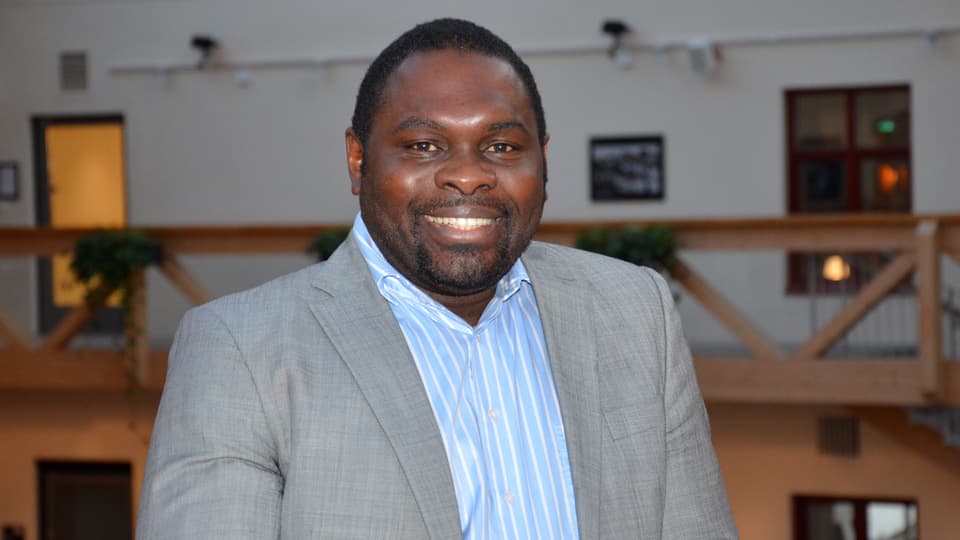
Welcome to a dissertation in Media and Communication Studies with Christian Nounkeu Tatchou who will defend his doctoral thesis "Journalistic cultures matter: Mainstream news media responses to disinformation in Sub-Saharan African and Western Countries".
Date: 4 September 2026
Time: 10:00
Location: Mid Sweden University, Campus Sundsvall, C312. You may also attend via Zoom. Please use the link below.
Chair: Professor Jonas Harvard, Mid Sweden University
External reviewer: Professor Raul Ferrer Conill, Stavanger University
Examining committee:Professor Henrik Örnebring, Karlstad University Professor Kristin Skare Orgeret, Oslo Met, Professor Gustav Lidén, Mid Sweden University
Abstract
The past two decades have been marked by the increased propagation of disinformation in the public sphere and its emergence as a structural feature of our contemporary media environments. This remarkable surge in the spread of false and misleading claims is partly due to the advent of social media and artificial intelligence, which anyone can use to produce and circulate information, without necessarily having to ensure its accuracy and reliability. The dissemination of disinformation is potentially harmful for democracy, as it can lead to political polarisation; violence; cynicism; as well as public distrust in political processes, political actors, and democratic institutions.
The news media is one democratic institution threatened by disinformation as it challenges the very essence of journalism, which is to provide accurate information to citizens to help them make informed choices. In this context, mainstream news media throughout the world have been pushed to respond to disinformation. These responses mostly involve fact-checking and corrective news reporting. However, mainstream news media show variable conceptions, approaches, and practices regarding fact-checking and corrective news reporting, with significant differences across political and media systems. These differences suggest that national journalistic cultures, which are negotiated from contextual constraints and pressures, might have a significant influence on how mainstream news media understand and fact check and correct disinformation within distinct political and media environments. Against this background, this dissertation aims to understand how journalistic cultures influence mainstream news media responses to disinformation across Sub-Saharan Africa and Western countries. This research uses seven countries as case studies: four democratic countries including three in the West (France, Sweden, and the United States), and one in sub-Saharan Africa (South Africa); two countries in sub-Saharan Africa which are transitional democracies (Kenya, Nigeria) and one authoritarian country in sub-Saharan Africa (Cameroon).
This dissertation is theoretically grounded in journalistic culture theory. Methodologically, it employs a mixed-methods design, namely quantitative content analysis and qualitative in-depth interviews. The results show that mainstream news media responses to disinformation in the democratic countries mainly reflect the influence of monitorial journalistic culture. Nevertheless, the priorities differ significantly across France, South Africa, Sweden, and the United Sates, primarily because of the diverse ideologies supported in respective media systems. Furthermore, the results show that the mainstream news media responses to disinformation in the transitional countries, reflect the influence of more multilayered and hybrids journalistic cultures. However, the interventionist role of journalism tends to be more emphasised in Kenya which has more experience with democracy than in Nigeria which came out relatively recently from a long succession of military rules. This is suggestive of the possibility that experience with democracy has implications on interventionism. Moreover, the results show that the mainstream news media responses to disinformation in the authoritarian country, Cameroon, reflect the influence of ad hoc journalistic cultures, circumstantially adopted and adapted, for navigating contextual freedom restrictions, political repression as well as, social and economic constraints.
In view of these results, I argue that journalistic responses to disinformation are conditioned by journalistic cultures embedded within broader political, media and democratic contexts.