Visiting researcher Alberto Sanchez Rojas explores future scenarios for tourism‑intensive areas
Alberto Sanchez Rojas is researching how tourist-intensive destinations along the Spanish coast can be developed in a future characterized by complex challenges and rapid changes. Now the doctoral student from the University of Málaga is visiting ETOUR for three months.
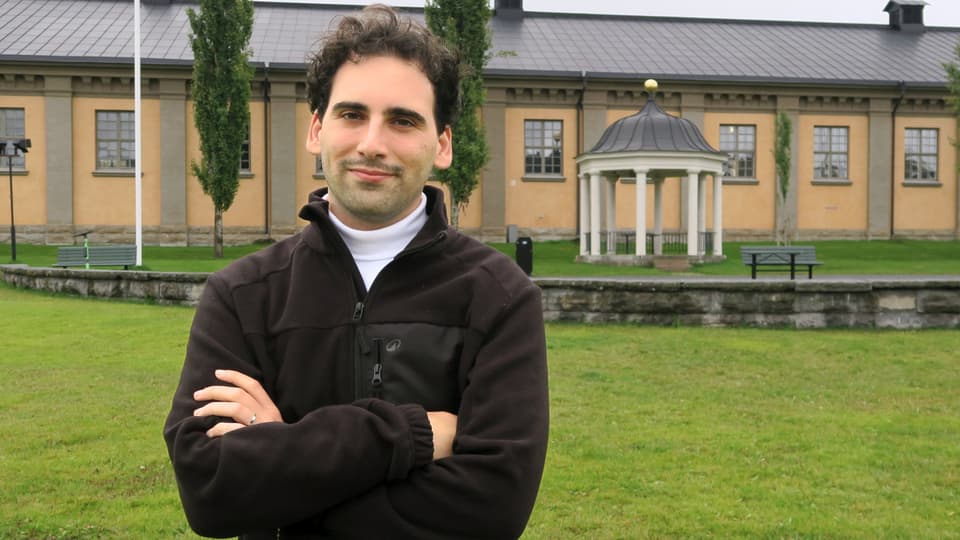
Hi Alberto, you have recently joined us at ETOUR at Mid Sweden University in Östersund as a visiting researcher. Could you to tell us about your background?
I live in Málaga, Spain and grew up in Algeciras. Science, research and creativity have always interested me and after trying my hand as a youth, I began to understand that tourism – which has a huge impact on Spain – is a complex and interdisciplinary phenomenon. It fascinated me that tourism can be studied from so many perspectives.
In 2020, I moved to Málaga and started studying tourism at the university. In the first four years, I became increasingly involved in research and participated in research programs for students. In 2024, I started working as a research assistant in digital and coastal tourism, designing experiments to study future scenarios in contested tourism environments.
In 2025, I started my Master's degree in Tourism Management while working as an administrative officer at IATUR, the Tourism Research Institute in Málaga. This gave me the opportunity to continue researching future scenarios, and in the same year I was also admitted to a training course for university teachers, which gave me the opportunity to become both a doctoral student and a teacher at the university.
You are researching future scenarios in tourist-intensive areas. Why did you become interested in this specific area of research?
In my thesis, I explore how coastal tourist destinations can be affected and developed in the future in a time characterized by several simultaneous crises, so-called polycrises. These are areas along the Spanish Mediterranean coast where economic, political, social and ecological challenges interact, and I use future scenarios and new technologies to investigate how people and actors imagine the future of these tourist-intensive areas. The goal is to identify which factors are most important when future images and future visions are formed in tourist-intensive coastal regions.
My research is in the borderland between tourism and futures studies, a broad field of research where I am particularly interested in the collective and socio-spatial notions that we use when we think about the future. For example, it can be about how we imagine a destination in ten, twenty or thirty years, who gets to help shape the future images and what future scenarios we can imagine as possible at all.
The field requires a strong interdisciplinary perspective, which is common in tourism research. One of the most fascinating aspects of tourism is precisely that it constantly forces us to look at the same phenomenon from different disciplines and perspectives.
My interest in trying to see into the future was actually awakened long before I knew that there was such a thing as futures studies. Even as a child, I used to think about what the coming years would look like or what the world might look like in a hundred years. At home there were books and movies that my parents had read or seen in the 1980s. I thought it was extremely exciting to see how people at that time imagined the world that my own generation would later grow up in.
I also think that my interest in trying to look into the future is related to the fact that I belong to a generation that has grown up surrounded by rather pessimistic stories about the future. Climate change, economic crises, conflicts and housing shortages. Often we talk about the future as something that we have to protect ourselves from. I would say that there is a kind of generational lock-in, when it comes to imagining different future scenarios. This is another reason why I think the subject is so interesting to study.
A defining moment was when I read The Year 2000 by Herman Kahn and Anthony J. Wiener. Then I discovered that future scenarios are a systematic way of thinking about what has not yet happened. When I read the book, I was already studying tourism at university, but suddenly I saw a connection between these ideas and questions of place and territory.
Over time, I have become interested in exploring the future in different touristic environments. For me, a place is the physical environment that tourists visit, but also the memories, the identity, the social relationships, conflicts, desires and beliefs that the place holds. By studying how different people imagine the future of the place, we can begin to understand where we are going and what time we are creating.
What made you choose to visit ETOUR and for how long are you planning to stay?
I heard about ETOUR three years ago when my colleague Fátima Santos-Izquierdo did a research exchange here, and in 2025 Sandra Wall-Reinius, Associate Professor of Human Geography at ETOUR, also visited the University of Málaga. During the three months we spent together, she told us about the research centre, different research areas and similarities she saw between ETOUR and IATUR.
When I started my doctoral studies, I was therefore already sure that I wanted to experience ETOUR and Östersund. And here I am now, almost a year later. I will stay for three months from September to December 2026.
This is my first research stay abroad as a doctoral student and one of my goals is to strengthen the theoretical foundation of my thesis. Based on what I have seen of ETOUR and the research here during my first weeks, I feel like I have come to the right place.
What do you hope to be able to work with when you have completed your doctoral studies?
I hope to continue working as a researcher and university teacher for many years to come. I like the academic world. Not only because it gives me the opportunity to do research and learn new things, but also because of the opportunity to interact with society and contribute to change.
I do not believe that academia can function in isolation. Reality is full of nuances, knowledge and experiences that are difficult to understand from an academic perspective alone. For me, research is also about creating channels that enable knowledge from outside to enter academia, while at the same time the researchers' knowledge benefits society. Knowledge needs to be disseminated at both levels.
I would like to work from a perspective where knowledge is co-created with the people who live in and shape the places I study. I see the relationship between the people and the place as a symbiosis. Universities contribute with tools to interpret and predict certain processes, while society contributes with experiences, needs and knowledge to understand them.
From IATUR to ETOUR. How does your background relate to the research and expertise that is found here in Östersund?
At first glance, the context around ETOUR is different from the one I am familiar with in Spain. The landscape, the climate, the Swedish cultural heritage, the relationship with nature and the right of public access create different conditions for tourism development. These differences are also a reason why I wanted to come here.
If we were to study only places that we already know, I think there is a risk that we start to regard certain processes as universal when in fact they are strongly linked to specific places. Visiting Östersund gives me the opportunity to compare and see what happens when the context changes.
It is also fascinating to discover that many of the issues we study in Östersund and Málaga are surprisingly similar, despite the differences in context. The relationship between residents and visitors, access to land and resources, spatial change processes, conflicts of interest and justice issues exist in both Málaga and Jämtland, although they take different forms.
And of course, the team of researchers at ETOUR and the opportunity to work more with Sandra Wall-Reinius were also important factors in visiting Östersund. I met Sandra when she was doing guest research in Málaga in 2025. She was interested in understanding the dynamics of an intense tourism region like Málaga and exploring issues related to territorial justice and tourist justice.
At that time, I was working as an administrative officer at IATUR and I acted as her interpreter for three months. It was both interesting and fun. We tried to show Sandra our tourism region as honestly as possible, with strengths, contradictions and conflicts, and we learned a lot together along the way.
At some point, Sandra mentioned that I should come to Östersund. I took her advice seriously and here we are now. Another three months at the same university, but this time in northern Europe.
How have the first weeks in Östersund been? How have you been received, and is there anything that has made a special impression?
Since I came to Östersund, the team at ETOUR has been incredibly friendly and really done their best to make me feel welcome. Before I came here, I thought that the first few days would be a bit difficult. A new country, a new university, a different language and new routines. My colleagues quickly got the feeling to disappear. I have felt welcome and at home from the start, and yes, I have definitely become fond of having Swedish fika!
One thing that I find interesting is how the students and doctoral students at Mid Sweden University are really included in academic discussions. During the first few weeks, I have seen how the students participate in seminars, presentations and various forums for discussions, and I really appreciate the feeling that students become an active part of the university's community.
Östersund also had a surprise in store for me. When I arrived here, I discovered that Candela del Barrio, a classmate from my master's degree in Málaga, was also at ETOUR. A happy discovery! After these first weeks, I can say that I am more than happy to be here at Mid Sweden University. There is still a lot left to discover, learn and experience, which makes it even more exciting.
With this, we would like to say a warm welcome to Alberto. We look forward to having you here with us at ETOUR and Mid Sweden University during the autumn!
