Visiting researcher Jean Miczka studies how mountain areas are managed and who gets access to nature
When access to nature is limited by climate change, lack of resources for maintenance and land conflicts, questions of justice and rights are raised. Researcher Jean Miczka from the University of Lausanne is now visiting ETOUR for 6 months to study these issues in a Swedish context.
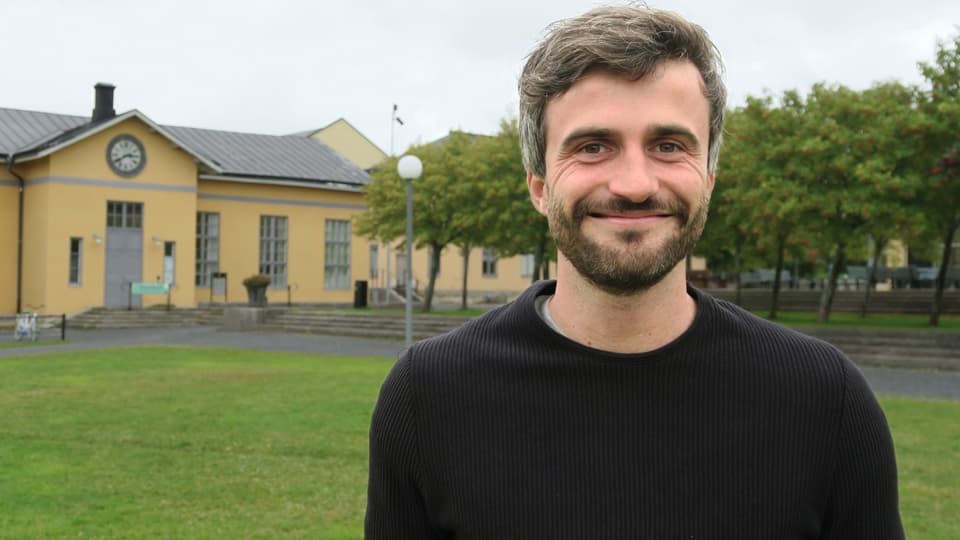
Hi Jean, you have recently joined us at ETOUR at Mid Sweden University in Östersund as a visiting researcher. Could you to tell us about your background?
I am from France, but have been working in Switzerland for the past few years. I have an academic background in political science and international studies, but over time I have moved towards geography and tourism. This is because I have become increasingly interested in how societies plan, organize and change environments in mountainous areas.
Recently, I finished my PhD studies in tourism studies at the University of Lausanne in Switzerland. In my dissertation, I studied the governance and management of less developed mountain areas, with a particular focus on the interplay between tourism, climate change and various forms of regulation.
I am still affiliated with the University of Lausanne where I now have a research position and my time at ETOUR is funded by the Swiss foundation Société Académique Vaudoise.
You are researching the governance and management of mountain areas. Why did you become interested in this specific area of research?
My research is broadly concerned with the governance and management of mountain areas, outdoor recreation, and access to nature. More specifically, I am interested in how access to mountain areas is regulated and negotiated, as well as how conditions change as a result of climate change, nature conservation, tourism development, and a growing interest in outdoor recreation.
My curiosity about these questions grew when I was working on my dissertation during my time as a doctoral student. I realized that access to nature in parts of the Alps is becoming increasingly limited. There are many different reasons why this has come to be the case. Some examples are climate change and nature conservation, legal issues regarding accidents and liability, lack of resources to maintain trails and conflicts over land use.
This raises a very interesting question for me. As climate change contributes to extreme heat becoming a growing problem, access to cooling natural environments may become more important as an opportunity to get away from hot urban environments. At the same time, we are seeing increasing restrictions in access to many of these places. Access to lakes and other attractive natural areas is being commercialized, while access to mountain environments is being more tightly regulated.
This has made me wonder if these issues can be understood from a justice perspective and if access to nature can be considered a rights issue. I am still exploring this area and do not start from any given answer, which makes it exciting.
This also makes Sweden particularly interesting. The Swedish right of public access, allemansrätten, provides different perspectives on access to nature than the French and Swiss contexts in which I have worked before. I am interested in understanding how the right of public access, and the idea behind it, works in practice. The area has a very natural connection to the research conducted at ETOUR and being here in Östersund allows me to study these issues in a mountain region where outdoor life is a natural part of people's everyday lives.
What do you hope to be able to work with in the future?
Now that I have received my PhD, I want to continue working in the borderland between research and practice. I am particularly interested in research that contributes to understanding and managing changes in mountain areas, while at the same time the research is closely linked to the people who live there and the organizations that operate there.
So-called Research-Action is an important part of my work and way of working. I enjoy conducting research together with the people who are directly involved in the places and issues I study, as opposed to only producing knowledge about them. I want to continue to develop this way of working and contribute to research that creates value for both academia and practitioners.
In the long term, I hope being able to continue working in research while collaborating with public authorities, outdoor organizations, and local actors on the issues that I am exploring.
What made you choose to visit ETOUR and for how long are you planning to stay?
I wanted to further develop my research on access to mountain environments in a Swedish context. Östersund is a particularly interesting place for this. ETOUR has strong expertise in tourism, outdoor recreation and sustainable tourism, while the research here has close links to the mountain areas in Jämtland and Härjedalen.
During my time as a visiting researcher at ETOUR, I will develop an exploratory and comparative research project between Sweden and Switzerland. I want to get to know the research environment here and hope to lay a foundation for collaborations that can continue even after my stay at ETOUR. The hope is that this initial work will develop into a larger research project and I am currently applying for funding from the Swiss National Science Foundation to have the opportunity to pursue my research further.
How have the first weeks in Östersund been? How have you been received, and is there anything that has made a special impression?
My first impression has been very positive. I have been warmly welcomed by everyone. Before I came here, I was told that Swedes can be quite reserved, so it has been a very positive surprise.
As someone who comes from the Alps, I have naturally been curious to discover Jämtland's mountains and outdoor life. The landscape is different in many ways from what I am used to, but there are also many similarities in how people use and relate to the mountain environments. The close connection to outdoor life in everyday life here is in many ways reminiscent of what you can see among people who live around the Alps. It has already given me many ideas to use in my research.
The only real challenge so far has been the weather in Jämtland. I brought paragliding equipment with me, but was perhaps a little too optimistic. So far, I have only managed to fly once, and therefore I hope for a few calmer days before winter comes, so that I have the opportunity to experience Jämtland from above.
With this, we would like to say a warm welcome to Jean. We look forward to having you here with us at ETOUR and Mid Sweden University during the autumn!
