Amanda develops eco‑friendly air filters using triboelectric principles
PhD student Amanda Stolpe is exploring how triboelectricity can be integrated into air filtration systems to create efficient and sustainable solutions. By using cellulose—a natural, green material—she aims to design filters that capture fine particles while allowing air to flow freely.
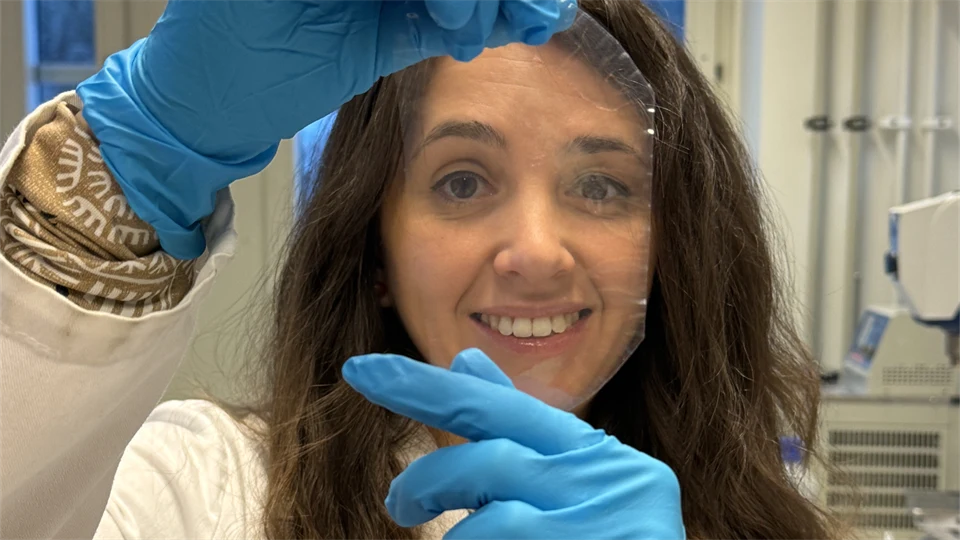
Tell us about your research!
My research focuses on integrating triboelectric principles into air filtration systems. Triboelectricity occurs when two materials exchange electrons, creating opposite charges. By applying this concept to filter materials, I aim to continuously charge the surface so it attracts and captures fine particles without requiring an extremely dense structure. This means cleaner air with less airflow resistance.
Most conventional air filters use synthetic materials, but I’m exploring cellulose as a sustainable alternative since it’s an excellent electron donor. Ultimately, my goal is to develop an optimized triboelectric material for use in face masks or ventilation systems—combining efficiency, comfort, and environmental responsibility.
What do you hope it will contribute to?
I hope that my research will contribute to finding a more environmentally friendly option to conventional air filters, that can deal with the small airborne particles that are usually very tricky to collect.
What challenges have you faced in your research?
The challenge right now is to make our triboelectrically well performing regenerated cellulose films into a permeable material, suitable for filter application. And to figure out the design that will best support the triboelectric performance.
What are you looking forward to in the next stage of your research?
Right now, I am very excited about doing an exchange abroad, in France, next year, where I’ll learn to make cellulose aerogel materials.