She develops the energy‑efficient pulp of the future
With the goal of reducing energy use in the pulp industry, Dia Pornpan Kongthong is developing a new high-yield pulp for linerboard. As a PhD student at Mid Sweden University and FSCN Research Centre, she combines innovative processes to create stronger fibres with a lower climate footprint.
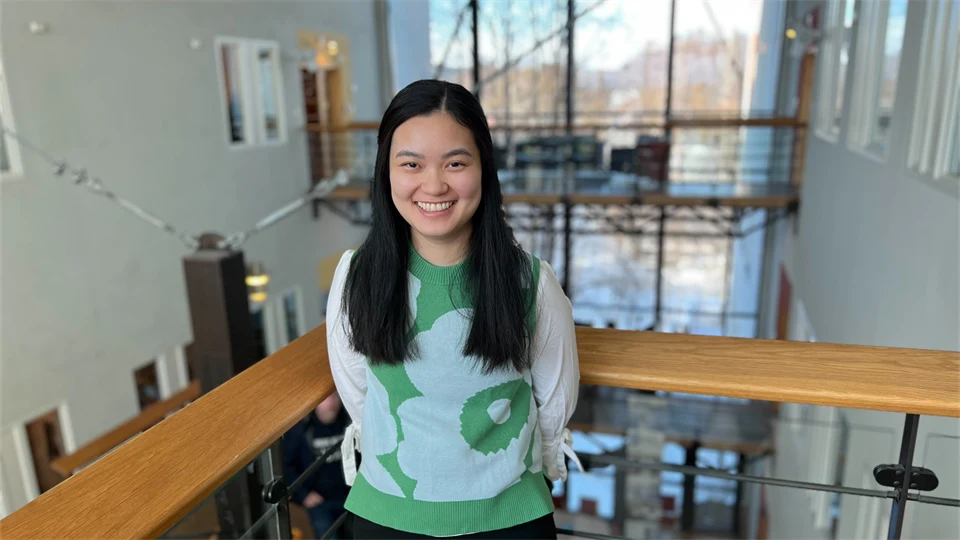
What is your background?
I moved from Norberg to Sundsvall in 2017 to study a Master of Science in Engineering Chemistry. Already during my education, I knew that I wanted to continue in academia and become a doctoral student. After graduating, I applied for a PhD position at FSCN. It took some time for everything to be ready, and in the meantime I worked as a laboratory assistant at Nouryon.
How did you come to choose to do your PhD at FSCN and Mid Sweden University?
During my studies, I worked a lot with polymers and wanted to continue in that area. At the same time, research on paper pulp was close at hand, so FSCN felt like the right research environment for me. The combination motivated me to invest in research in this field. I started my PhD position in February 2025.
What is your research about – and what do you hope it will contribute?
I am researching to develop a new high-yield compound that meets or exceeds the requirements for linerboard – i.e. the outer layer of corrugated cardboard. The goal is to produce the pulp with lower energy consumption in refining and increase product yield, reduced climate and emissions impact.
The project is part of Emission Free Pulping, where we collaborate with companies and also universities in Finland.
What methods or materials do you work with in your project?
I work with low-energy thermomechanical refining called the Chemi-Asplund process, where chemicals are used in the mechanical pre-treatment to soften the lignin and improve fiber separation. This is followed by a mild delignification to fine-tune the fibre properties.
An important goal is to get as much as possible out of the raw material – i.e. the wood chips. Compared to chemical pulp, mechanical pulp offers higher yields, and we want to combine the advantages to both improve material properties and reduce environmental impact.
We use high temperature and high pressure to reduce the energy requirement in the subsequent process. I am also working on removing more lignin. Some of the experiments will be carried out in a laboratory environment at Valmet.
What challenges have you encountered so far – and what has been the most rewarding?
Not many people do research in this particular area, and not all tests can be carried out at FSCN. Therefore, cooperation with Finnish researchers and companies is very valuable. It is rewarding to be able to discuss ideas with more than just my supervisor.
How do you experience the research environment and the collaboration with colleagues at FSCN?
There is a strong competence here, and the colleagues are very helpful and supportive. It is inspiring to work in an environment where many people are running exciting projects – also in other research areas.
What are your long-term plans?
I would like to continue in academia, although I am also open to working in or close to industry. What attracts academia is the freedom – both in the choice of specialisation and in how you plan and prioritise your work.