Sabbatical in Florence to strengthen research on sustainable wood treatment
Magnus Norgren, Professor of Chemical Engineering at FSCN Research Center, is on site at the University of Florence for a three-month sabbatical, where he advances research on more environmentally friendly wood treatment methods and builds future collaborations.
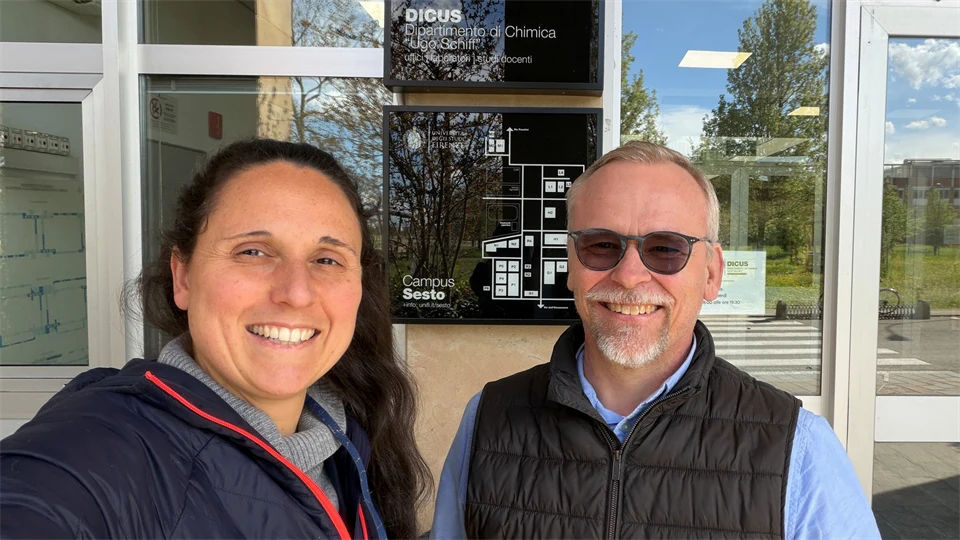
Magnus Norgren sees the stay as an opportunity to deepen his research and spend more time in the laboratory.
"It will be an opportunity to broaden and deepen knowledge. I'm really looking forward to working more hands-on in the lab again," he says.
The research environment in Florence is internationally known for its work in surface and colloid chemistry, including research on how chemical formulations can be used to preserve and restore art objects in wood. This knowledge can also be relevant for new types of wood treatments in industry.
"It's exciting to come to an environment where we understand each other but work with different specializations. We work with different parts of the same field, and I hope to be able to take lessons learned from there and see how we can create collaborations in the future.
Learning from the experience of other researchers
A central part of the research is about so-called microemulsions – very small droplets of one liquid in another. Magnus Norgren's research group is conducting research on how to use turpentine, a product from wood, which is mixed with water and surfactants to form such structures. The result is droplets that are so small that they can penetrate the pores of the wood. This opens up new methods of treating wood without the high-pressure processes that are often used today, for example in copper impregnation of decking timber.
"Instead of using advanced machines and high pressure, you can basically dip the wood in the emulsion. Then a kind of self-impregnation takes place when the small droplets penetrate the material.
The research group in Florence has extensive experience with just such formulations and how they interact with wood, especially in the work of preserving historical objects and works of art. Magnus Norgren now wants to explore this knowledge in a broader perspective.
Already in 2016, he met Professor Piero Baglioni, who founded the Research Centre for Surface and Colloid Chemistry at the University.
"When we started our project on microemulsions, this collaboration came to the surface again. Within Europe, Italy, and especially Florence, is something of a center for this type of research.
More long-term cooperation
During the stay, Magnus Norgren will also teach the university's PhD students in polymers. At the same time, he hopes to lay the foundation for a more long-term collaboration between the research environments.
"I want to bring with me working methods, methods for characterization and how they work with their systems. The hope is that we can build up a collaboration, for example around doctoral students or joint research applications. Gaining access to their infrastructure and skills through a partnership would be very valuable.
He sees the fact that the sabbatical takes place in Florence as an added bonus.
"Of course, being able to be in Florence and see how art and science can go hand in hand in a very concrete way is also inspiring.