Master’s student explores laser processing for more recyclable food packaging
How can paper-based packaging be made more water-resistant without relying on plastic or aluminium? This is the question Fabio Basoni is exploring during his master’s thesis at FSCN Research Centre at Mid Sweden University.
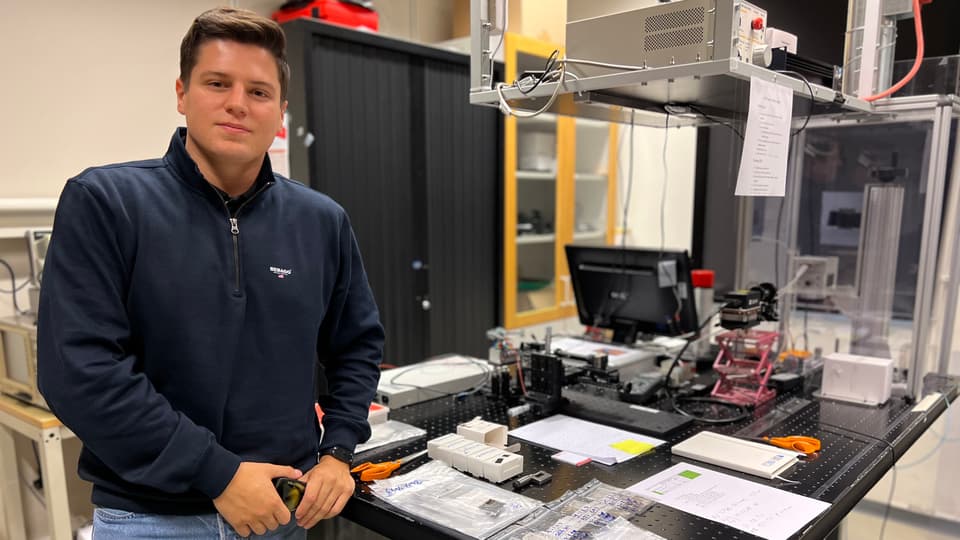
Fabio is a master’s student in Mechanical Engineering at the University of Parma in Italy. He arrived in Sundsvall in August and will spend four months at FSCN, where his research forms part of both his master’s thesis and a preliminary study at Mid Sweden University.
His research focuses on coated paperboard for food packaging. Fabio is investigating how laser processing can modify the surface of the material and improve its hydrophobic properties – in other words, its ability to repel water.
“I test the surface of the cardboard in different ways to see how its hydrophobic properties change after laser processing. I am also investigating how different laser patterns and cuts affect the material, including whether air and gases can move through the cardboard,” Fabio explains.
Reducing the need for plastic and aluminium
Paperboard is already widely used for food packaging, but additional layers of plastic or aluminium are often needed to provide the required barrier properties. These combinations can make packaging more difficult to recycle.
The research therefore explores whether the properties of paperboard can be improved in other ways.
“If we can improve the cardboard so that we can reduce the use of plastic and aluminium, it could make packaging easier to recycle. It could also reduce the use of fossil-based materials and energy,” Fabio says.
The project also includes a potential antibacterial application. Laser processing can create changes to the surface structure, and Fabio is investigating whether these properties could contribute to antibacterial surfaces. Samples are being prepared at FSCN and sent to a laboratory in Gothenburg for testing.
Research with an industrial connection
The work is carried out in collaboration with the Italian company Nanoprom, which develops coatings and paints and is interested in solutions for superhydrophobic surfaces.
For Fabio, working at FSCN Research Centre provides access to research infrastructure and expertise that he would not normally have at his home university.
“It is very interesting for me to use my theoretical skills in the laboratory. I have been able to use the laser lab and the SEM microscope, as well as other instruments in the labs. The dialogue with researchers and the exchange of knowledge is also a great part of the experience.”
Fabio says the opportunity to work closely with researchers has been an important part of his time in Sundsvall.
“They have been very kind and welcoming. I got a very good introduction to the university, the laboratories and the city.”
For Fabio, the experience has also provided an opportunity to experience student life in Sweden.
“Sundsvall is pretty similar to Parma - not too big and easy to get around. It is also close to outdoor activities and sports. There is a good social life and a welcoming student community. I would definitely recommend Mid Sweden University for exchange students.”