3D‑printed prototype contributes to more efficient leg kicks
Within the research project Augmented Sports, companies and organizations are offered support for the development of both equipment and technology. One project participant, Dan Nilsson, has received help to produce prototypes of 3D-printed equipment that will improve the technique in breaststroke.
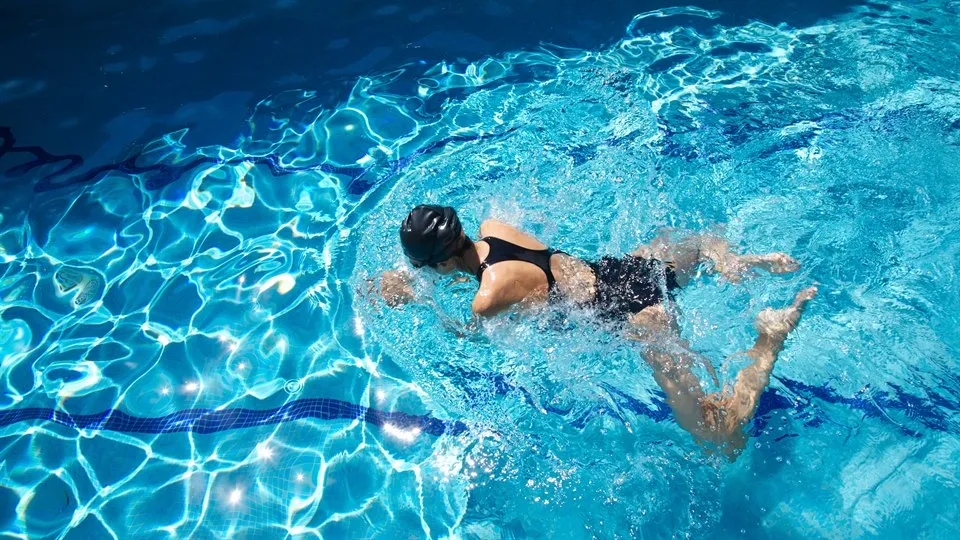
"When my daughter started swim training in her swimming club and was going to focus on breaststroke, I saw that the leg kick was a rather unnatural movement. That's when I started thinking about how I could help her in her training," says Dan Nilsson, who runs a company in product development himself.
He got his idea for swimming equipment about a year ago, and then contacted the Sports Tech Research Centre.
"At first, this was just an idea to do something for my daughter's and her little brother's swimming training, then the level of ambition grew and I thought that maybe it could be commercialized. The biggest contribution from the research engineers was to get help to make the prototypes. We have also talked a little about materials that have the right properties," says Dan.
Frog leg kick or whip kick
Within breaststroke, there are a couple of different techniques of leg kicks that are used by the active.
"The Lifesaving Society teaches frog leg kicks, which are easier to learn. The Swedish Swimming Federation is looking to swim as fast as possible and they recommend whip kick, says Dan.
He further explains that a cross-section of a human is shaped like a rectangle, and as a swimmer, you want to keep your body and legs together within that rectangle to reduce resistance in the water.
"You want to put your energy into moving forward. The philosophy is therefore to keep the body as compact as possible. It provides a shorter distance to move the legs and the swimmer does not have to move as much water. You get that effect by using a so-called whip kick instead of a frog leg kick, says Dan.
The 3D-printed prototype is held in place using the thighs to isolate them from the movement, resulting in the swimmer being able to use only the lower legs. In this way, they are forced to use the right type of kick, a so-called whip kick.
"I have received a total of 15 prototypes from the research engineers, of which the swimming club has borrowed half a dozen to test both in the younger groups and among the semi-professional swimmers of high school age. The beginners are mainly judged from the edge of the pool, while the more experienced swimmers have told us that they find the equipment quite difficult because you can't be careless with the leg strokes, says Dan.
One of those who has contributed to the development of Dan's idea is research engineer Magnus Ahnesjö at the Sports Tech Research Centre at Mid Sweden University in Östersund.
"Even though we only helped with the production of the prototypes, it has been exciting to hear how it turned out and whether the training method gives any results. It's extra fun when we can help local companies develop innovative ideas and in this case also the local associations," says Magnus.
In the future, Dan hopes to develop the product further and even commercialize it, although it requires large investments in patents, both in Sweden and abroad.
"Without the help of the research centre, I would not have come this far and been able to produce so many copies of the prototype," Dan concludes.
The collaboration has been carried out within the framework of the Augmented Sports project, which is carried out with the support of the European Regional Development Fund/Swedish Agency for Economic and Regional Growth, and in which the municipality of Östersund is also involved as a financier. Through this type of collaboration, so-called open innovation, partners gain access to advanced lab equipment and new knowledge to develop their own operations.
Read more about Augmented Sports