Public defense of doctoral thesis with Isaac Sánchez Leal
Welcome to a public defense of doctoral thesis in Electronics with Isaac Sánchez Leal who will present his thesis "Partitioned Deep Neural Network Inference on Resource-Constrained IoT Devices: A System-Level Methodology".
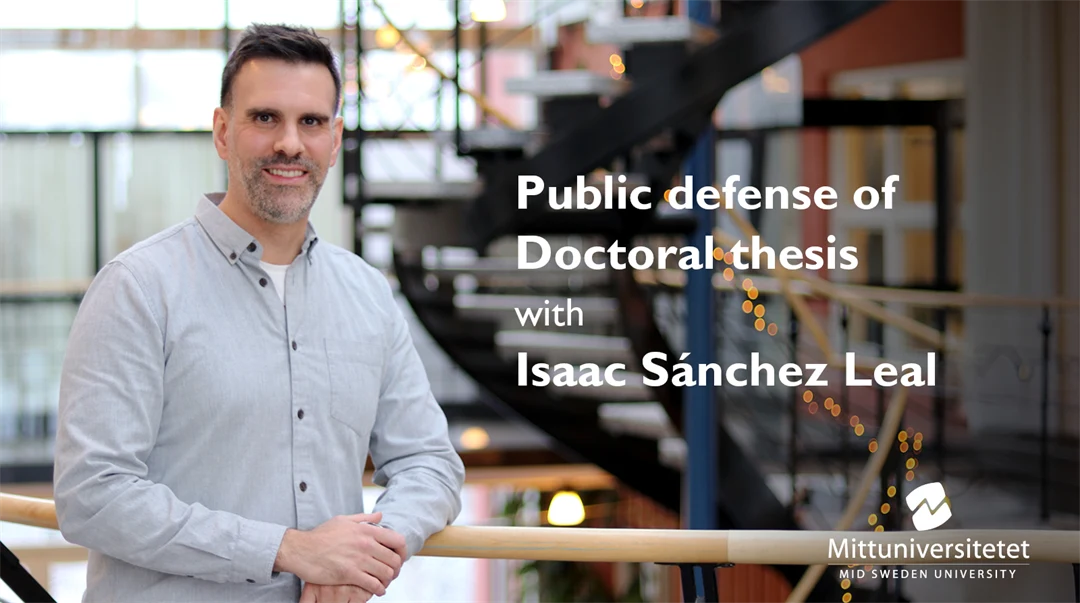
Welcome to join the seminar where Isaac will present his PhD work on Partitioned Deep Neural Network Inference on Resource-Constrained IoT Devices. He will introduce a system-level methodology that enables efficient and accurate execution of partitioned DNNs.
Date: February 18, 2026
Time: 09:00
Place: Campus Sundsvall, L-building, Room L111, and online via Youtube and Zoom.
Doctoral thesis: "Partitioned Deep Neural Network Inference on Resource-Constrained IoT Devices: A System-Level Methodology"
Respondent: Isaac Sánchez Leal
Supervisor and Chair: Professor Mattias O’Nils, Mid Sweden University.
Co-supervisor: Dr. Irida Shallarim, Mid Sweden University
Opponent: Professor Johan Lilius, Åbo Akademi, Finland
Examining committee:
Professor Per Gunnar Kjeldsberg, NTNU, Norge
Associate Professor Oscar Gustafsson, Linköping University
Professor Francesco Bonavolontà, University of Naples
Backup: Associate Professor Johan Sidén, Mid Sweden University.
Abstract
The proliferation of the Internet of Things (IoT) has driven the deployment of Deep Learning models on constrained edge devices. However, a fundamental conflict exists between the computational demands of Deep Neural Networks (DNNs) and the strict energy and processing limits of battery-operated nodes. While intelligence partitioning offers a potential solution by offloading computation to a server, practical deployment is hindered by the structural barrier of modern DNNs, which are characterized by intensive early-layer computation and intermediate data expansion, creating critical bottlenecks in distributed environments. This thesis presents a system-level methodology to bridge the gap between algorithmic demands and hardware constraints.
The research begins by identifying the governing parameters of system efficiency through a systematic analysis method and a Design Space Exploration (DSE) method. Based on these core determinants, a co-design strategy is introduced to overcome the structural barrier to partitioning. By synergistically combining model- and data-level transformations, this approach induces efficiency at potential partition points, significantly reducing node energy consumption and system latency. Finally, the thesis proposes an accuracy recovery method to effectively decouple node efficiency from application accuracy. By shifting the paradigm from loss mitigation to compensation, this reconstruction engine ensures that performance is maintained relative to the baseline accuracy even under extreme optimization actions.
In summary, this thesis establishes a system-level methodology for the efficient partitioning of DNNs. It demonstrates that by operationalizing the presented formal design workflow, it is possible to exploit the capabilities of resource-unconstrained servers to maximize node battery life and minimize system response time. This work lays the foundation for ubiquitous intelligence, enabling the deployment of advanced AI on resource-limited hardware by transforming the structural limitations of DNNs into opportunities for distributed efficiency.