Farangis Foroughi Highlighted Advances in X‑ray Imaging at MAX IV
Last week, Farangis Foroughi, PhD student at STC, gave a presentation about her research at the MAX IV Laboratory, as part of their MAX4Life Talk Series.
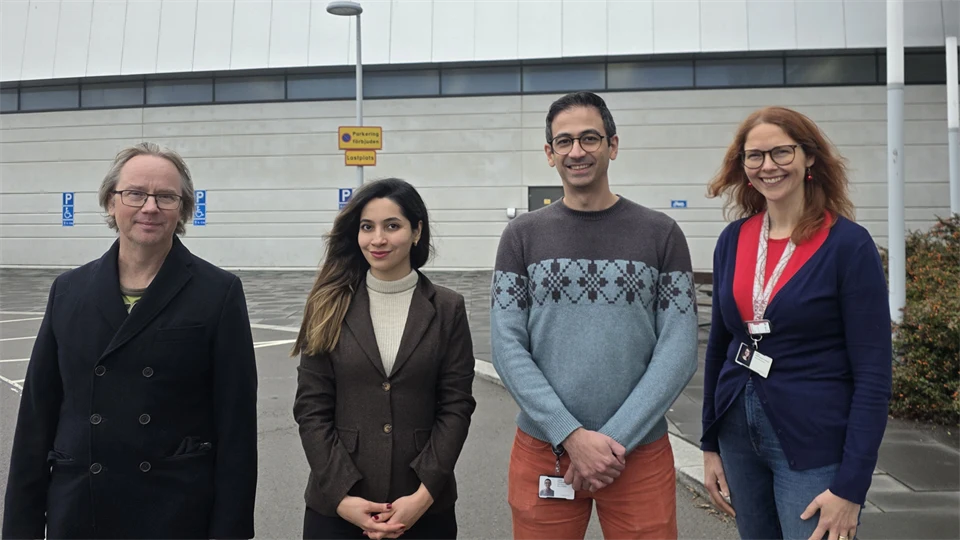
At the MAX IV synchrotron laboratory in Lund, research is conducted using synchrotron light – a highly intense X-ray light that enables scientists to study material structures down to the atomic level. Last week, Farangis Foroughi, PhD student at STC, was honoured to be invited there to speak about her research and the ongoing developments in X-ray technology.
– The idea of giving a seminar first came up during a networking discussion at the IWORID25 conference in Bratislava. A few months later, further discussions about the potential development of a biomedical imaging beamline at MAX IV highlighted that my PhD research could be particularly relevant. From there, I was invited to give a seminar for the MAX4Life series, says Farangis.
New analysis tool – MIR2
Farangis conducts research on Multiple-Image Radiography (MIR) – a type of X-ray technique that not only shows how much radiation is absorbed by a material but also how the rays bend and scatter at very small angles. This makes the technique extremely sensitive to subtle differences in soft tissue, such as in the lungs. Her presentation at MAX IV focused on recent advances in using MIR to produce clear, low-dose X-ray images of living lungs. This work is based in part on a new analysis tool called MIR2.
– A major part of our progress has been improving the analysis and stability of MIR. Our new analysis method, MIR2, addresses limitations such as sensitivity to system instabilities, alignment drifts, and noise. This makes the extraction of MIR contrasts more robust, quantitative, and reproducible, even under challenging imaging conditions, says Farangis.
The presentation was a good opportunity for Farangis to share her PhD work and connect with the MAX IV community. The timing also made the day special, as her MIR2 paper was published in the Journal of Physics in Medicine and Biology just minutes before the seminar, which added an extra sense of excitement. At the end of the presentation, the audience had the chance to ask questions – something that Farangis greatly appreciated.
– The audience showed genuine interest in both the technical aspects of MIR and its biomedical applications. I appreciate when people ask questions, as it opens up new perspectives and often points to future directions worth exploring. The interaction was encouraging and made the session feel even more rewarding.
A Visit Full of Inspiration
This was Farangis’ first visit to MAX IV. Having a strong interest in synchrotron facilities and the wide range of scientific techniques they enable across many fields, she previously visited Elettra and the Diamond Light Source. Farangis found MAX IV very impressive, and during her visit, she toured several beamlines and learned about their techniques and current developments.
– The beamline scientists were incredibly welcoming, and I am so impressed that Sweden has a fantastic light source that has led the revolution of new or upgraded facilities around the world! The visit was both inspiring and motivating, and it encouraged me to explore how the techniques available at MAX IV might enhance or complement our ongoing investigations. I also hope that colleagues at Mid Sweden University recognize the remarkable research opportunities that MAX IV offers, and that MAX IV can see the value of the work being done at Mid Sweden University in areas that are important for society. The visit encouraged me to think about future possibilities and potential collaborations between these research environments, says Farangis.
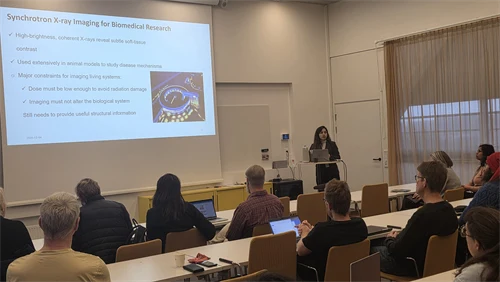
Farangis Foroughi presented her research at MAX IV on 4 December 2025.