From industry to research: Ola Gatner’s PhD journey into 3D perception
What began as a fascination with seeing the world through a sensor has developed into research on making low-cost lidar sensors more reliable. For PhD student Ola Gatner, who recently held her midterm seminar, the journey has also meant changing direction and tackling unexpected challenges.
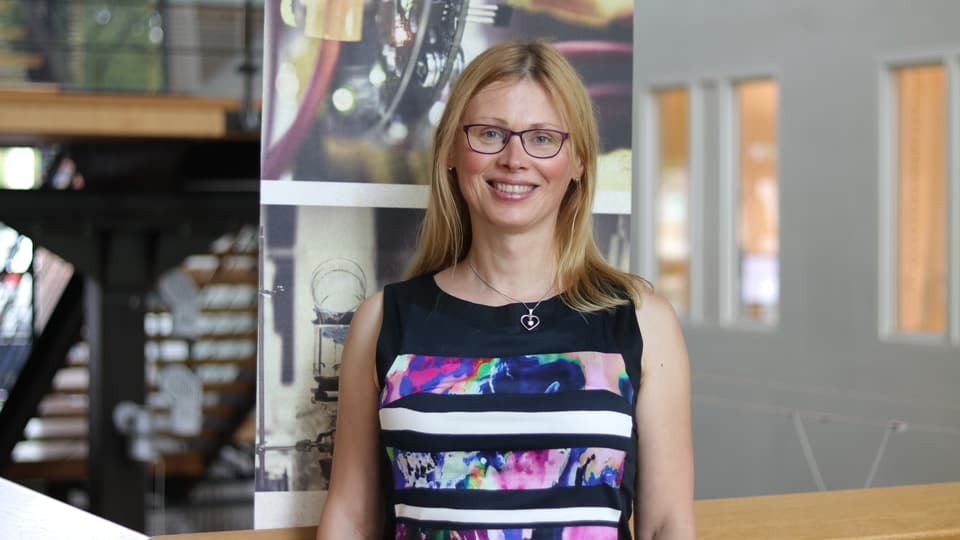
Ola Gatner’s interest in 3D perception began while working as a consultant for HIAB in Sundsvall. An internal project involving lidar sensors sparked a fascination with how a sensor could capture the world in three dimensions. Through the project, Ola met current co-supervisor Imran Khan, who, together with Hans Lyngback, introduced her to Mid Sweden University.
The research focuses on the accuracy of low-cost lidar sensors, which use laser light to measure distances and create 3D representations of the surroundings. Reliable depth information is essential for applications such as robotics, autonomous vehicles and safety systems.
When research takes an unexpected turn
Ola initially planned to focus on 3D object segmentation and recognition. But the work soon revealed that even a simple lidar scan of a room could contain significant errors, many caused by multipath interference — when laser light reflects off several surfaces before returning to the sensor.
Existing solutions often rely on combining lidar with an RGB camera, but this approach has limitations in strong ambient light and low-light conditions. Unable to find a satisfactory solution, Ola made the problem itself the focus of the research.
Ola and the research collaborators are now close to presenting an algorithm that uses the sensor’s own data streams and geometric information to identify and remove these errors, without requiring an additional camera.
Research is genuinely fun: exploring different directions, asking ‘why?’ and trying to find the answers
The challenges and rewards of a PhD
Understanding scientific papers and reproducing the methods described in them can be demanding. AI language models have recently helped her translate methods from papers into Python code that can run on the research data, making parts of the process faster.
But for Ola, the greatest reward is the opportunity to explore and understand.
“Research is genuinely fun: exploring different directions, asking ‘why?’ and trying to find the answers,” Ola says.
The next step: More realistic simulations
During the second half of the PhD, Ola aims to model lidar sensor errors so they can be added to computer-generated 3D scenes. The goal is to make simulated data resemble real sensor measurements, allowing researchers to train and test new methods on large datasets without the time and expense of collecting everything in the real world.
"Looking back, the unexpected challenges have helped shape the research. What started as an interest in recognising objects in 3D has become a deeper investigation into how to ensure the sensor data behind that recognition can be trusted", Ola says.