Lukey explores how AI can predict industrial machine failures
Lukey Clark is researching how machine learning can help detect faults in industrial machinery before they lead to costly breakdowns. As a PhD student within IRS TransTech, he combines simulations, sensor data and AI in collaboration with Newcastle University, Mid Sweden University and SCA.
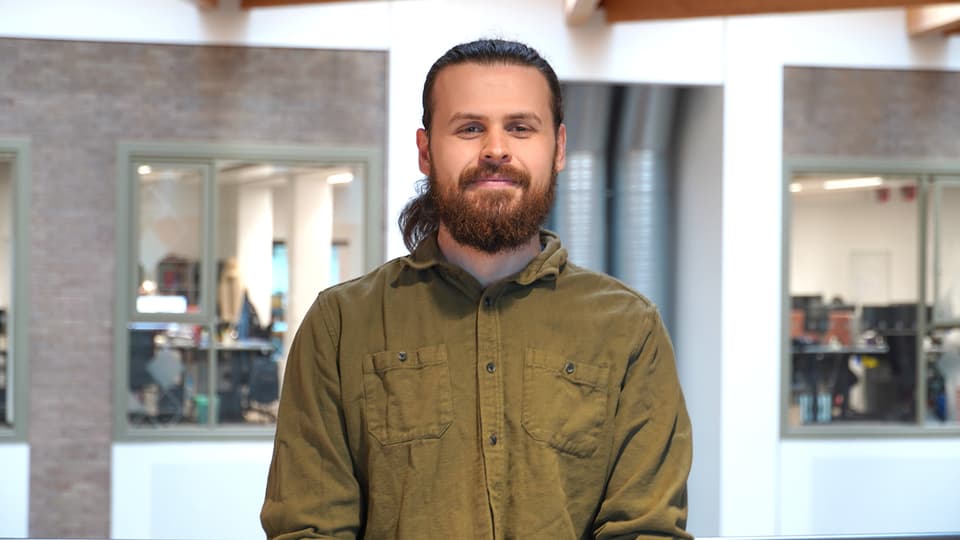
Could you tell us a little about your background and what led you to your PhD?
I studied Electrical and Electronic Engineering at Northumbria University before completing a Master's degree in Embedded Systems and IoT at Newcastle University. During my Master's, I became interested in machine learning and how it could be implemented on resource-constrained embedded devices.
After graduating, I worked as a Research Assistant at Newcastle University, developing embedded monitoring and control systems for wastewater treatment research. That gave me experience with sensors, electronics, data and real engineering systems, and sparked my interest in condition monitoring and predictive maintenance.
I realised that I really enjoyed research and wanted to explore these engineering problems in more depth, so a PhD combining machine learning, industrial systems and condition monitoring felt like a natural next step.
Why did you choose the IRS TransTech Research School?
What attracted me to IRS TransTech was the combination of academic research, international collaboration and industry.
My PhD brings together Newcastle University, Mid Sweden University and SCA, so the structure of TransTech fits the project very well. I also liked the opportunity to become part of a wider network of PhD students and researchers working with different aspects of industrial technology.
What are you researching, and what problem are you trying to solve?
My research focuses on using machine learning for condition monitoring and predictive maintenance of industrial machinery. The aim is to use data from machines to detect developing faults and identify when maintenance may be needed. Detecting problems early can help reduce unplanned downtime and make maintenance more efficient.
One of the main challenges is that industry often has large amounts of data from machines operating normally, but relatively little data from real faults. I am investigating whether physics-based simulations can generate realistic fault data that can be combined with real measurements to develop better machine-learning models.
At the moment, I am focusing on gearboxes and how different gearbox faults affect vibration signals.
Your PhD involves three different organizations. How does that collaboration work in practice?
Being part of Newcastle University and Mid Sweden University gives me access to different areas of expertise and research environments. I am mainly based at Newcastle University during my first two years, where I am supervised by Dr. Domenico Balsamo, while also working with Dr. Sebastian Bader at Mid Sweden University.
The collaboration with SCA is particularly valuable because it connects the research to real industrial challenges. SCA provides industrial knowledge and access to data from machinery in real production environments, allowing me to test how the methods work under realistic operating conditions.
We have regular meetings involving the universities and SCA, so although we are based in different places, there is a lot of interaction and collaboration.
What are you most looking forward to during your PhD?
I am excited to see the project develop from the modelling and simulation work I am doing now into something that can be tested using industrial data.
I am also looking forward to spending more time at Mid Sweden University and working more closely with SCA. Working across universities and industry was one of the things that appealed to me most about this PhD, and I am looking forward to making the most of that experience.
What have you learned so far from your PhD journey?
One thing I have found interesting is how much the direction of a PhD develops as you begin to understand the problem in more detail. I started with the broader area of industrial condition monitoring, but my work has gradually become more focused on the challenge of limited fault data and how simulation and machine learning could be combined to address it.
Read more about the International Research School in Transformative Technology