Nordic collaboration to help small industries benefit from AI
How can small industrial companies use AI to strengthen their competitiveness? This is what the research project NextIndustriAI aims to explore. Researchers and experts from Sweden, Finland and Norway recently gathered in Sundsvall to exchange experiences and strengthen their collaboration.
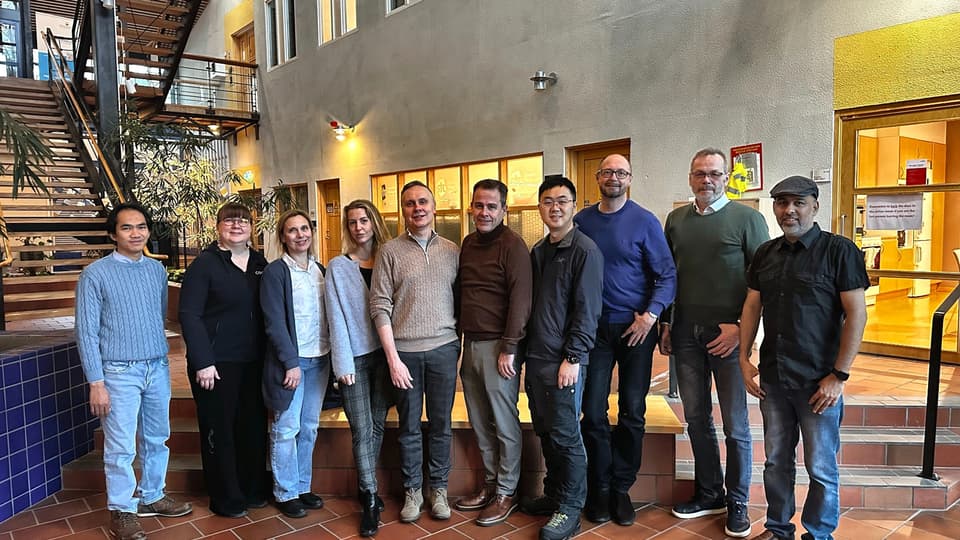
Artificial intelligence is creating new opportunities for industry, but smaller companies often struggle to understand how to apply the technology in practice. The three-year research project NextIndustriAI aims to address this challenge. Funded by Interreg Aurora, the project brings together Centria University of Applied Sciences in Finland, Mid Sweden University and UiT The Arctic University of Norway.
The goal is to help micro and small enterprises explore how AI can be used in their production environments to improve productivity, profitability and competitiveness.
“Many companies say they want to start using AI, but they don't know how to get started. The technology offers incredible opportunities, but companies need support to take the first steps,” says Jonna Björk, project manager at Centria University of Applied Sciences.
Mazhar Hussain, project manager at Mid Sweden University, also highlights the challenges of turning AI's potential into practical applications.
“One of the main challenges for small and medium-sized industrial companies is the gap between the potential of AI and knowing how to apply it in practice. Many companies have valuable production data but lack the resources, technical expertise, or experience needed to turn that data into useful insights.”
Sharing experiences and addressing common challenges
Over two days, project partners gathered in Sundsvall to discuss ongoing activities and plan the next steps. The first day focused on presentations and workshops, where participants shared experiences from their respective organisations.
An important part of the project involves working on real-world industry cases, where researchers and experts explore how AI can help address different industrial challenges.
“We presented the progress we have made in our industry cases, the challenges we have encountered, and worked together to find solutions. It is exciting to be part of such a research-driven project where we really have the opportunity to explore these issues in depth,” says Jonna Björk.
Mazhar Hussain emphasises the importance of meeting in person to strengthen collaboration and explore new ways forward.
“These physical meetings give us a unique opportunity to work closely on the different work packages, discuss challenges, brainstorm solutions, and learn from each other's experiences in our respective regions. While online meetings are important for regular coordination, meeting in person allows for deeper discussions and often generates new ideas and perspectives.”
On the second day, participants visited Mid Sweden University's laboratories and research environments. They also discussed how to coordinate future activities and how the different areas of expertise within the project can complement each other.
Collaboration across national borders
For Jonna Björk, the project is not only about technological development but also about building networks between regions with similar conditions. Despite national borders, the project partners share many common challenges related to geography, climate and industry.
“Those of us living in these regions have a great deal in common. I would say that in many ways, we in Ostrobothnia have more in common with northern Sweden than with the Helsinki region. That is an important reason why we should collaborate even more,” she says.
Looking ahead, the work with participating companies will continue. The ambition is to identify recurring challenges and develop solutions that can benefit a wider range of businesses. The results and experiences will be shared through seminars and workshops, helping more small industrial companies take advantage of the opportunities offered by AI technology.
NextindustriAI is funded by support from Interreg Aurora. Read more about the project here.