Field tests provide new insights into optical measurement of salt on asphalt
How do asphalt, environment and wavelengths affect measurements of salt on roadways? A degree project at NTNU in Trondheim and tests within the SENAVIS project provide new insights into how sensor technology can work in both labs and real environments.
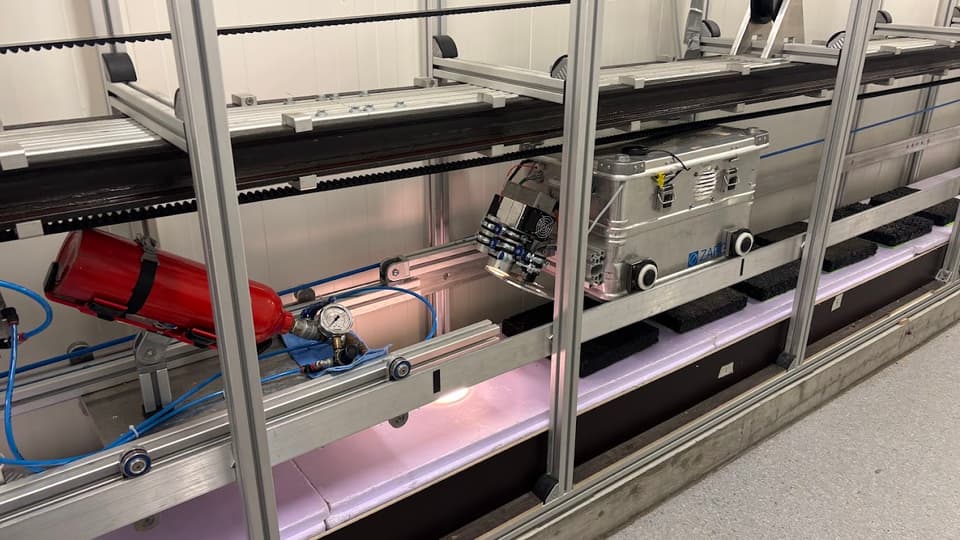
In a degree project at NTNU, optical measurement of salinity on asphalt is investigated using the MORAS-P1 (Mobile Residual Anti-icer Sensor) sensor. The work is carried out within the framework of the research project SENAVIS – Sensor technology for smart de-icing, a Swedish-Norwegian collaborative project between Mid Sweden University and NTNU.
The project is funded through the EU programme Interreg Sweden–Norway and through co-financing from regional and national actors in Sweden and Norway, with the aim of developing smarter methods for winter road maintenance and reducing the use of chemicals on roads and airports.
- In my work, I investigate whether the type of asphalt affects absorption, and how light absorption varies over different wavelengths, says Sara Berlin Boasson, master's student from NTNU.
Tests have been carried out both in a laboratory environment and in the field. In the lab, asphalt types, water film thickness and salinity were varied under controlled conditions. In the field, the sensor was tested in motion on an airport runway to evaluate how it performs in real-world conditions.
- We have tested MORAS-P1 both in the lab and in the field. The lab environment gave us control over the conditions, while the field tests showed how complex real-world environments affect the measurements, says Sara Berlin Boasson.
An important lesson from the work is how strongly surrounding factors affect the results.
- The most valuable thing has been to see how much real conditions such as surface, temperature and environment affect the measurements, she says.
The aim of SENAVIS is to develop sensor technology that can enable more precise dosing of de-icing agents in real time, which can reduce both costs and environmental impact.
- This type of test is crucial to be able to develop reliable sensors that work in practice. In the long term, it can contribute to both safer roads and reduced use of chemicals, says Sara Berlin Boasson.
The next step in the work is to further develop the method and analyze the data more thoroughly to ensure that the technology can be used in real-world applications.