Faeze holds halftime seminar on robust advertisement detection research
Faeze Zakaryapour Sayyad has presented her halfway seminar, showcasing research on robust and annotation-efficient advertisement detection in documents under domain shift. Her work combines academic and industrial perspectives to improve large-scale media analysis under real-world conditions.
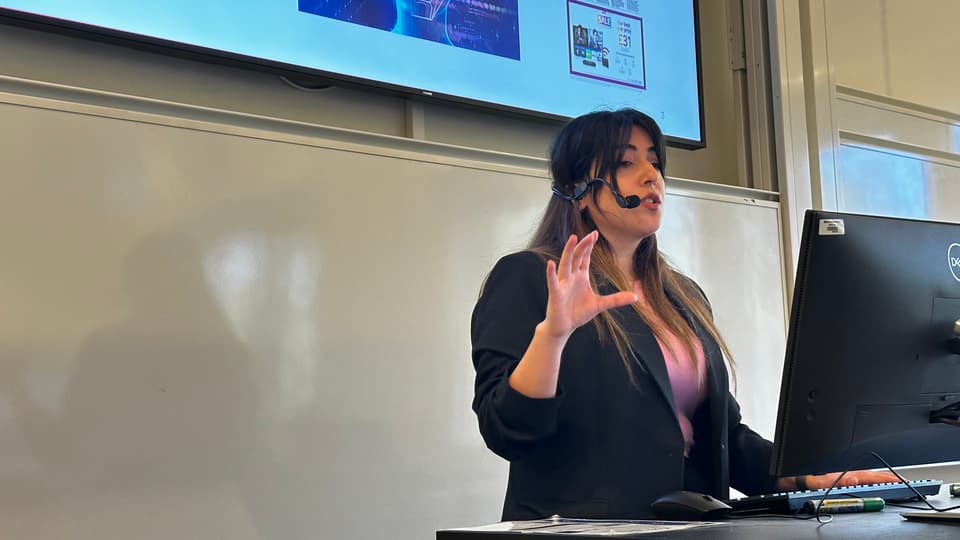
As part of her industrial PhD at Media Research AB Östersund, Faeze recently held her halfway seminar, presenting ongoing research focused on developing robust and annotation-efficient methods for advertisement detection in documents under domain shift, such as newspapers and magazines.
The research aims to create methods that are both accurate and computationally efficient, enabling large-scale processing of media data in real-world environments such as media monitoring and research. Reliable advertisement detection is an important foundation for analyzing advertising trends, monitoring publications, and generating insights from large media archives.
One important insight during my PhD has been that some challenges become visible only when combining academic and industrial perspectives
Over time, the project has evolved from primarily improving model performance to addressing broader challenges such as scalability, robustness under domain shift, and annotation-efficient adaptation across different newspaper layouts and publishers.
- One important insight during my PhD has been that some challenges become visible only when combining academic and industrial perspectives. Industry highlights practical constraints such as scalability, efficiency, and deployment, while academia contributes with deeper methodological investigation and systematic analysis, says Faeze.
A central challenge in the research has been domain shift - where differences in advertisement styles, publishers, and visual structures reduce the robustness of detection models across datasets. To address this, Faeze and her collaborators have explored adaptation methods using unlabeled target-domain data, reducing the need for costly manual annotations.
The presented results show promising improvements in cross-domain robustness, while also identifying remaining challenges that now shape the next phase of the research.
Looking ahead, Faeze will continue focusing on improving the robustness and reliability of the proposed adaptation framework, particularly under complex domain shifts and diverse newspaper layouts.
- I hope the research will contribute to developing more robust and annotation-efficient methods for document understanding, she says.