Building a career in the future of power electronics
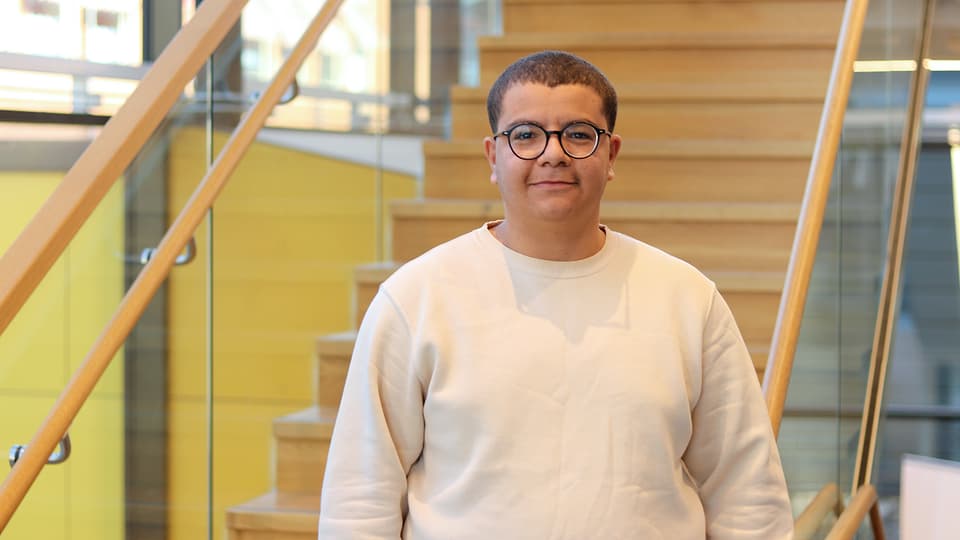
Rayen Selmi is a PhD-student at Mid Sweden University and part of the IRS TransTech initiative. His research focuses on developing efficient and compact power converters for future energy systems, in collaboration with ENIT in Tunisia and Powerbox AB.
What is your background?
I hold an engineering degree in Electrical Engineering and a master's degree in Information System Techniques from the National Engineering School of Tunis (ENIT), Tunisia. My background combines power electronics, embedded systems, PCB design, and artificial intelligence for embedded systems.
Before starting my PhD, I gained practical engineering experience through R&D internships, where I worked on embedded systems and embedded AI. I was also involved in research and development activities through the ENIT Robotics Club, where I had the opportunity to work on different technical projects and develop my interest in combining electronics, software, and intelligent systems.
How come you chose Mid Sweden University?
I joined Mid Sweden University through a cotutelle PhD agreement between MIUN and ENIT as part of the IRS TransTech initiative. What attracted me particularly was the opportunity to combine the expertise and research environments of two universities while working on a highly relevant topic in power electronics.
Mid Sweden University has strong expertise in electronics and power conversion. Working with the research team gives me the opportunity to combine theoretical work, simulation, design, and experimental validation. Another important aspect of my PhD is the collaboration with Powerbox AB, which gives my research a strong industrial connection. It allows me to work on research challenges that are not only scientifically interesting but also relevant to real-world power electronics applications.
What is going to be your focus during your PhD studies?
My PhD research focuses on the design and control of efficient, high-power-density, wide-voltage-range isolated DC-DC converters. Part of my research is based on Unbalanced-Flux Magnetics, or UBFM. The idea is to explore new magnetic structures that can improve the utilization of magnetic materials and potentially allow more compact and higher-power-density magnetic components.
The overall goal is to develop efficient and compact power converters that could be relevant for applications such as electric vehicles, data centers, and renewable energy systems.
What are your expectations of the PhD program and your research environment?
I expect IRS TransTech to provide a collaborative environment where I can develop both my technical and research skills. One of the things I value most is the opportunity to work with researchers from different backgrounds and to connect academic research with practical applications.
I am working with supervisors at both MIUN and ENIT, and my PhD also includes collaboration with Powerbox AB. This combination of academic and industrial expertise is very valuable to me because it allows me to approach research problems from both a scientific and an engineering perspective.
I look forward to using the advanced laboratory facilities at MIUN for experimental characterization and to sharing my research through international conferences and publications. I also see the international environment as an important part of my PhD, both for developing my research network and for learning from different perspectives.
How do you see your PhD studies contributing to your future career goals?
My PhD is an important step toward my long-term goal of becoming a specialist and researcher in high-power-density power electronics and advanced energy conversion systems. Through this PhD, I want to develop a strong combination of theoretical knowledge, practical engineering skills, and research experience. The collaboration between MIUN, ENIT, and Powerbox AB gives me the opportunity to gain experience in both academic research and industrial R&D.
In the future, I would like to continue working on innovative power electronics technologies, either in industrial R&D or in academia, and contribute to the development of more efficient and compact energy conversion systems.