Test of noise level zones in the library in Östersund
The library is currently testing whether the introduction of noise level zones can contribute to a better study environment that more students enjoy. The trial will last until the end of the semester.
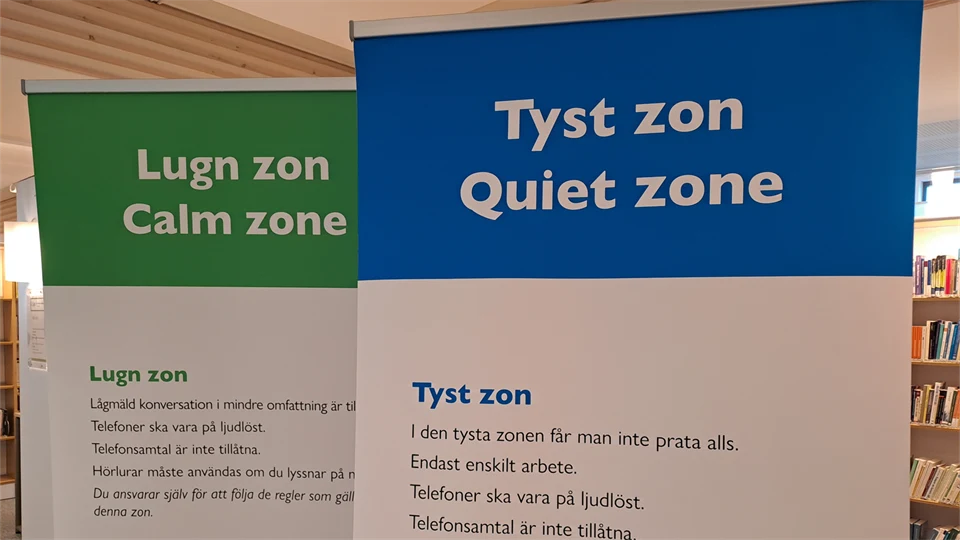
Why is the library doing this test?
Many students enjoy the library and want to be here, which we are happy about! But it can also get messy, and we often receive complaints about the noise level. The library is first and foremost a place for studying, and in order to be able to study, you need to have a tolerable study environment. The test with noise level zones is about seeing whether sound environment will improve if different noise levels can be concentrated in different places in the premises. We also want students to be involved and have an opinion about their study environment.
How do the different zones work?
The library is divided into three types of zones. At the entrance to each zone there are rules that you are expected to follow if you enter the zone.
Flex zone
In the flex zone you are allowed to talk and work in groups, but you need to think about your volume here too! It is best to talk quietly, or book a group room if you know you need to talk a lot. Avoid telephone calls. Speakerphones are prohibited and you must use headphones if you want to listen to something.
Calm zone
In the calm zone, quiet conversations are allowed to a limited extent. So no group work, only short conversations with a low sound level. The phone must be in silent mode and you must use headphones if you want to listen to something.
Quiet zone
The quiet zone is intended for individual work. Here you are not allowed to talk at all. The phone must be in silent mode and you must use headphones if you want to listen to something.
Of course we want to know what the students think!
At all workstations in the library, you will find a QR code, which takes you to a form where you can share your momentary observations about how the noise level zones work. A student can submit many different observations during the test period, preferably several per week! We want to know how the zones work over time. It is just as important to report when everything is working well as when something is not working!
In addition to these observations, there is also a whiteboard on the 2nd floor where you can write down your opinions.
What happens if the test is successful?
If the results are good and the zones are respected, the solution can be implemented permanently. In that case, the study places will probably also be refurnished.
What if you just want to meet and talk and play cards and stuff?
The Student House has a cosy environment for hanging out! The Student House is open to all students, you don't have to be a member of the student union to hang out there.