Organize and structure
By planning how you organize your research data from the beginning, you reduce the risk of unnecessary extra work later in the project. A clear structure makes it easier to work efficiently, follow up results, and collaborate with others.
Where do I store my research data during the course of my work?
When working with research data, it is important to choose storage solutions with an appropriate level of security based on how sensitive the information is. Use the information classification as a starting point. Only use IT systems and services recommended by Mid Sweden University to ensure both information security and regulatory compliance.
Digital storage
For research data that is only to be managed internally within Mid Sweden University, directories on servers can be used. They are suitable for both sensitive and non-sensitive information.
When sensitive information needs to be shared, either internally or with external parties, the vault – secure management of sensitive information is used.
For collaboration and sharing of information that isn't sensitive, SharePoint and OneDrive are recommended.
Local storage can be used for open research data, but means that you as a researcher are responsible for ensuring that the data is stored and protected in a secure manner.
Physical storage
If you need to temporarily store research documents or research data close to the business, fire-rated cabinets can be used, provided that the cabinets and premises meet the requirements of the National Archives according to RA-FS 2013:4. Here you will find more information about the requirements that apply to cabinets, premises, climate and fire classification: Requirements for storage in fire-rated cabinets.
How should I organize and describe my files?
Use a logical and consistent folder structure that makes it easy to find and understand the data material, both for yourself and for others who may need access to it. Keep raw data separate from processed material and gather the project’s documentation in a clearly defined location.
Use clear file names with dates (write dates as YYYY-MM-DD), version numbers (e.g. _v1, _v2), and a short description of the content. Avoid spaces in file names and remain consistent throughout the project.
Choose file formats that function over time and across different systems. Ensure that files are created in formats that remain usable over time or can be converted without loss of information.
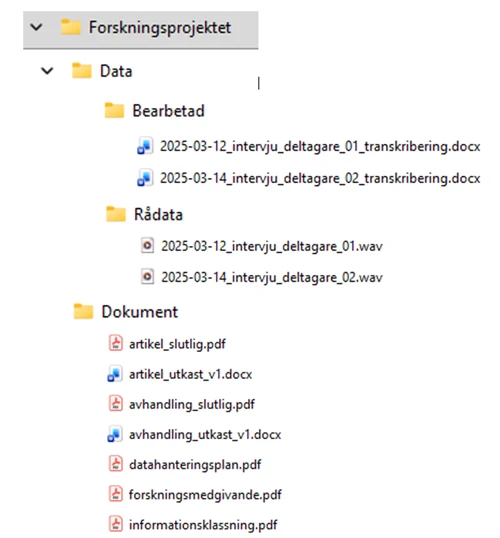
Image: Example of folder structure and file naming in a research project.
Contact