7.5 million from the Swedish Research Council for 6G research at Mid Sweden University
Mid Sweden University receives 7.5 million SEK from the Swedish Research Council for the research project "Towards robust and convergent manufacturing systems for 6G." The goal is to develop communication systems that can anticipate disruptions and act before they affect industrial processes.
Industry is becoming increasingly connected. Machines, robots, sensors, and control systems communicate wirelessly and often need to be able to respond within very short timeframes. But in industrial environments, radio signals can be blocked, interference can occur, and the conditions for communication change rapidly.
In the research project "Towards robust and convergent manufacturing systems for 6G," researchers at the STC Research Centre at Mid Sweden University will investigate how communication systems can detect such changes in advance and take action before they lead to interruptions or delays in production.
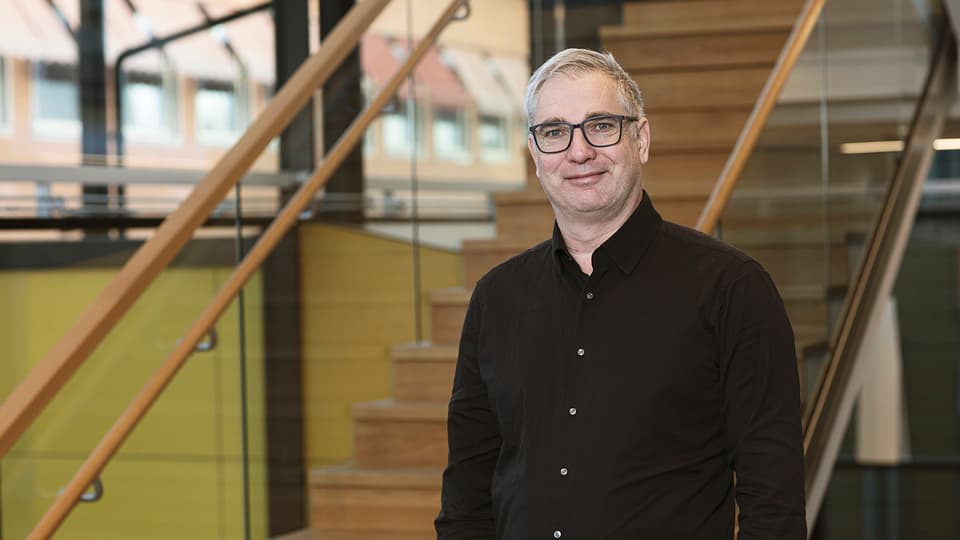
!Today, communication systems often handle problems when they have already occurred. We want to investigate whether it is instead possible to detect that something is going wrong and take action before it has consequences for production," says Mikael Gidlund, professor of computer engineering at Mid Sweden University and project manager.
An important part of the research is to consider the entire communication chain. The information passes not only through wireless 5G and future 6G networks but also fixed networks, computers, and control systems before it reaches, for example, a robot or a machine. The researchers want to develop methods that allow these parts to interact and ensure that information reaches within the required timeframe.
This becomes especially important as industry automates and uses more autonomous systems. A delayed control signal can be just as problematic as a signal that never arrives.
"The really difficult part is what happens when communication doesn't work as it should, and whether the system can still continue to perform its task safely. We try to combine the changes in wireless communication with industrial control systems' need for clear guarantees that information arrives on time," says Mikael Gidlund.
The project has been granted 7.5 million SEK from the Swedish Research Council and is carried out in collaboration with researchers at the University of Connecticut and the University of Iowa in the USA, two leading research institutions in the field. The collaboration gives the research group access to complementary expertise and advanced experimental environments. Together, the researchers will work with everything from theoretical models to experiments and practical validation.
The grant is part of the Swedish Research Council's and the American National Science Foundation's joint initiative for research on the sixth generation wireless communication system (6G), called VINES (Verticals-enabling Intelligent Network Systems).
"The Swedish Research Council's project grants are applied for in tough national competition. The grant is an important recognition of the quality of the research we conduct and of the work the entire research group has put in over a long period. It gives us the opportunity to continue developing the group and take the next step in research," says Mikael Gidlund.
Two doctoral students will be recruited for the project. Recruitment has already begun and has so far attracted over 130 applicants. At the beginning of 2027, a joint kickoff meeting with partners in the USA is planned.
The researchers will initially identify which types of disturbances and changes in industrial environments need to be foreseeable. Thereafter, methods will be developed and tested through theoretical analyses, simulations, and experiments.
The results may also have significance outside industry. Similar requirements for reliable communication exist in, for example, autonomous transport, energy systems, and other critical societal infrastructure.
Contact person:
Mikael Gidlund, professor of computer engineering at Mid Sweden University and project manager, 010-142 86 92, mikael.gidlund@miun.se
Contact