Ulf chose a research‑focused Master’s in Engineering Physics
A high degree of flexibility, close contact with researchers and the opportunity to carry out his own research project. These were some of the reasons why Ulf Enarsson chose the Master by Research in Engineering Physics at Mid Sweden University.
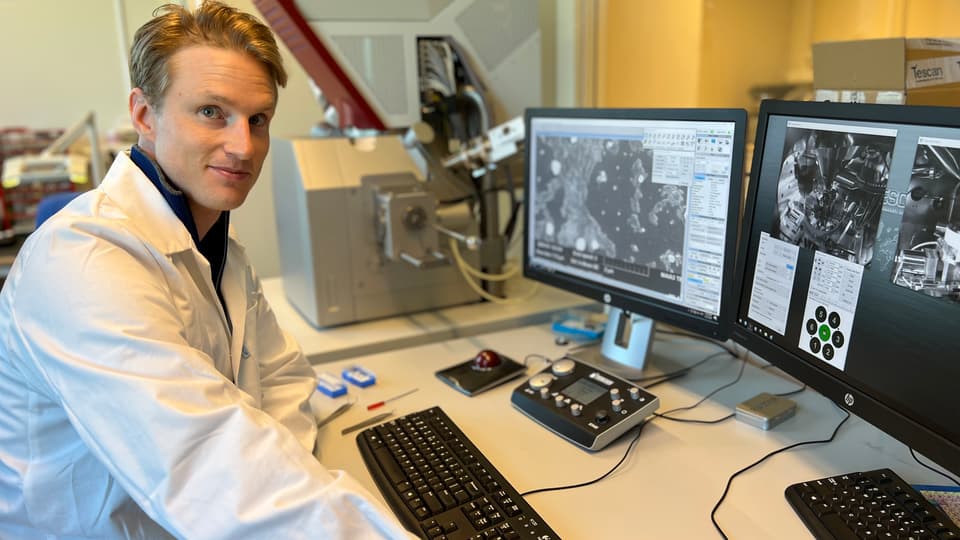
What made you choose the Master by Research in Engineering Physics at Mid Sweden University?
– During my bachelor’s degree in physics, I took part in a collaboration between Karlstad University, Linnaeus University and Mid Sweden University. That’s when I met Magnus Engholm from Mid Sweden University, who told me about the Master by Research programme. I was immediately interested, and Magnus is now my supervisor.
It sounded perfect for what I wanted from my studies. I wanted to be able to choose courses based on my own interests, and that’s how the programme works. You don’t have that same degree of freedom at larger universities. I was also attracted by the close contact with supervisors, professors and researchers. I was particularly interested in AI applications in research, and here I had the opportunity to work with exactly that.
What do you find most interesting or rewarding about studying a research-focused master’s programme?
– The best thing is being able to really immerse yourself in an area you’re genuinely interested in. You get started right away and have a great deal of freedom to shape your own development.
I’ve had regular meetings with my supervisor, but otherwise I’ve been able to plan and manage much of my own time.
You are carrying out your master’s project in the laser laboratory. Can you tell us about the project?
– I’ve been investigating how lasers can be used to produce nanoparticles. Traditionally, nanoparticles are often produced using chemical processes, which can result in impurities and are not particularly environmentally friendly. Using lasers, it is possible to create very fine particles, and the method can be used with many different materials. The challenge is that the process is slow, so the question is how it can be scaled up for industrial applications.
My work has focused on improving the particle synthesis process by investigating different ways of controlling it. As part of the project, I have developed software that brings different types of hardware together in a single user interface, allowing them to work together. Using AI models, we can then monitor the process in real time to identify the optimal parameters for a desired outcome.
What is it like to work so closely with research and researchers as a master’s student?
– It’s incredibly rewarding. I’ve had my own office at the university and have been able to work alongside researchers and doctoral students. If I’ve had questions, I’ve been able to talk to researchers working in the room next door. You really become part of the research environment and get an insight into the work being carried out.
What skills or knowledge have you developed during the programme that you think will be particularly valuable in the future?
– I’ve learned how researchers work and gained a good understanding of what it’s like to work at a university or research institute. I’ve also gained experience of running my own projects from idea to results. That’s a skill I’ll benefit from regardless of what I end up doing in the future.
What would you say to students who are considering applying to the programme?
– It’s a programme with a great deal of flexibility, where you have a lot of control over how you use your time. You can focus on what genuinely interests you and shape your studies around that. What sets the programme apart from many others is that you get to do something for real. You work hands-on with real research questions instead of simply reading about them.
What do you hope to do after graduation?
– I’ll continue working with, among other things, systems development. I already run two companies of my own, based on the experience I’ve gained in programming, AI and systems design during the programme. The best thing about the Master by Research is that you gain practical experience of taking your own projects from idea to implementation.