The answer came in five seconds ‑ it took longer to detect the error
AI can provide quick and convincing answers, but the information is not always accurate. Here are some tips on how to review AI-generated information and avoid relying on incorrect facts.
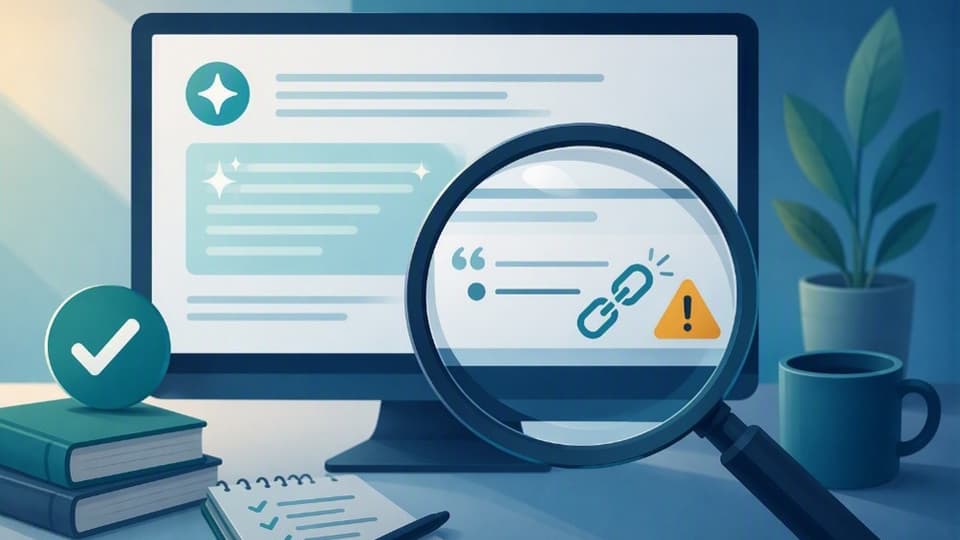
You need to quickly come up with a task and ask AI. The answer comes immediately, is clearly formulated and seems credible.
There is only one problem: Some may be invented.
Generative AI can present false data with the same certainty as correct facts. It can, for example, create a convincing reference to an article that does not exist or describe a rule without support in the university's current information. Such false or fictitious answers are usually called AI hallucinations. Since the answer often sounds reasonable, the error is not always easy to detect. It is therefore important to always be source critical, even when it comes to AI. Ask who is behind the task, what source it is based on and if it can be verified.
AI is great for structuring thoughts, processing text, and exploring ideas. But the more important the information, the more important it is to check the original source – especially in research, teaching, decision-making and information for students or employees.
When AI gives you exactly the answer you were hoping for, ask another question: How do I know this is actually true?
Perhaps the biggest risk is not when AI is clearly wrong, but when it is convincingly wrong.
Cybersecurity Month
In October, the so-called Cybersecurity Month will be held in Sweden and Europe. Umeå University, Mid Sweden University and Luleå University of Technology have together developed a common approach. The goal is to create good conditions for a strong cybersecurity culture through facts and educational materials