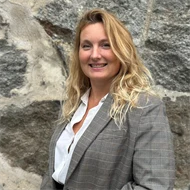
Mikaela Backlund
Mikaela Backlund is a doctoral student in Business Administration and is affiliated with CER – the Centre for Research on Economic Relations. Her dissertation work focuses on lifelong learning in a digitalised financial sector.
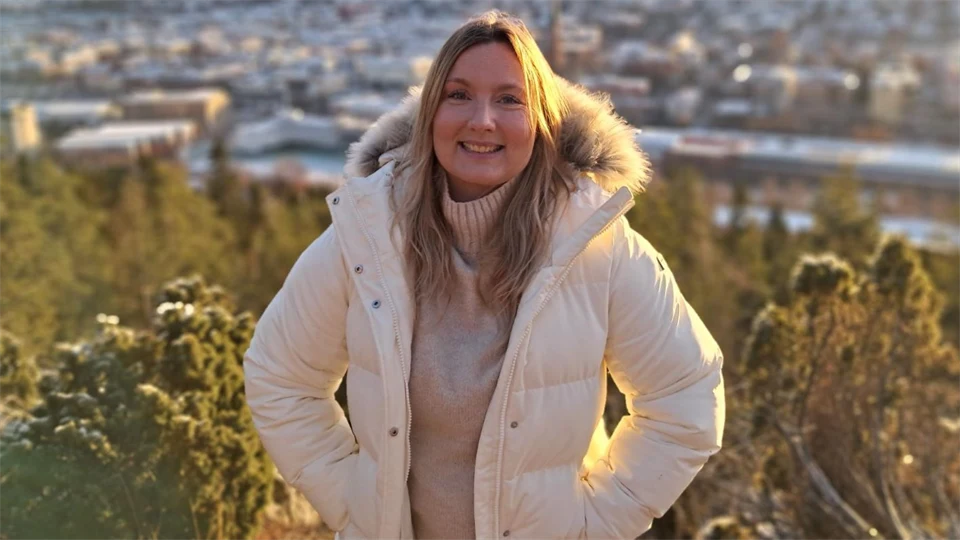
Tell us – who is Mikaela?
When I was a little girl growing up in Västra, I wanted to become an explorer, and that dream has never really left me. I’ve always been driven by a desire to understand more, see more, and figure out how the world works. That drive has partly led me to move around quite a bit, and partly to always find myself returning to the classroom.
After many years of exploring new environments and cultures and trying out both work and studies abroad, I decided this autumn to return to my home region. There is something about coming back to your roots that makes you see both yourself and the place in a new light… So I’m really looking forward to this adventure of rediscovering this fantastic region.
One reason I enjoy living here is the closeness to nature. There’s hardly anything better than walking up a mountain and sitting down at the top to do some yoga or meditation. In other words, I thrive outdoors and on the move. When I’m not outside exploring, I love diving into history and sociology, focusing on societal development and inequality. That’s often where I find inspiration – in stories about how people have lived, struggled, and changed their circumstances throughout history.
Can you describe your research project briefly?
My project is about lifelong learning in a digitalised financial sector, but I approach it from a perspective that includes both economic and humanistic dimensions.
Digitalisation creates changes in work tasks and competency requirements, and much of the organisational discussion therefore centres on efficiency, competitiveness, and skills provision – the more economic logic. But learning at work is also a matter of conditions, participation, security, and how people are given the opportunity to understand and manage change. That’s the part I highlight.
I am particularly interested in the learning that takes place in everyday situations: when you face new systems, need to solve unexpected problems, or negotiate new routines together with colleagues. It is often in these small, practical situations that larger change processes begin, and where the interaction between individual and organisation becomes visible.
How did you become interested in this area?
I see it as: the only constant in this world is change. Organisations and individuals must continuously adapt to new requirements, expectations, and ways of working. I realised early on that this process is not simple — it can create insecurity while also opening opportunities for development.
I also realised that learning is not just about courses or training programmes; it’s everything that happens “between the lines” in everyday work: when you experiment, fail, encounter something completely new, and when you together find new solutions.
I think working life says a lot about society as a whole — about opportunities, conditions, responsibility, and development. That drew me to these questions, for example how responsibility for learning is distributed when it becomes an integrated part of daily work rather than something you do on the side.
Why do you think this is important?
Workplace learning is truly underestimated as a strategic resource. People often say that employees are the organisation’s most important asset, but then you also have to invest in their development. When individuals are given the opportunity to learn and grow, organisations can grow with them.
Digitalisation means employees constantly face new tools, routines, and situations. You encounter problems you haven’t faced before, you need to understand new systems, and sometimes you have to learn very quickly. This can be both an opportunity and a challenge. Organisations need to get better at creating conditions that make such learning possible.
At the same time, learning also drives change. When people find new ways of working, question old routines, or discover more sustainable solutions, something happens on a structural level. This is where it becomes especially interesting to me: the interplay between individual, organisation, and society. That’s where the future of working life is shaped.
How do you divide your time between research and teaching?
Since this is my first term, I haven’t started teaching yet. At the moment, I have the privilege of focusing entirely on shaping my project and building a solid knowledge base. It’s necessary, especially since my project largely concerns pedagogical issues, which is a new field for me as my background is in business studies.
Right now, it’s perhaps more relevant to talk about how I divide my time between writing and reading. I try to write a little every day. Some days it’s hard to produce even a single coherent paragraph; other days I write for hours without noticing the time passing. I think the most important thing is simply to write something, even if it isn’t great.
I also believe in changing environments to stay focused. I alternate between the office, the library, and home, and I try to balance meetings and solitary work. If I have many meetings in a week, I focus on that and push most of the writing to the end of the week. I basically try to structure the work and stay present in what I’m doing.
Your dream scenario in terms of work?
For me, the dream scenario as a doctoral student is to work with something that truly makes a difference — both for people in working life and for the society we are part of. I want to contribute knowledge that can improve working conditions, strengthen people’s opportunities to develop, and create more sustainable workplaces over time.
Another important aspect for me is teaching. Being part of educating the next generation — the people who will shape future organisations and society — is something I find both meaningful and honourable. It’s a chance to share perspectives, spark curiosity, and create space for critical thinking.
Being able to combine research and teaching in a way that feels genuine, socially relevant, and developmentally rewarding — both for myself and for others — is exactly the kind of work I hope to continue doing.
Contact