Cleaner processes can pave the way for car production with greenhouse gas free materials
Solange Magalhães, a postdoctoral researcher at the FSCN Research Centre, develops bio-based alternatives to petroleum-derived substances used in industrial water treatment. Her work is a key part of Mission 0 House, a project aiming to enable materials and products without greenhouse gas emissions.
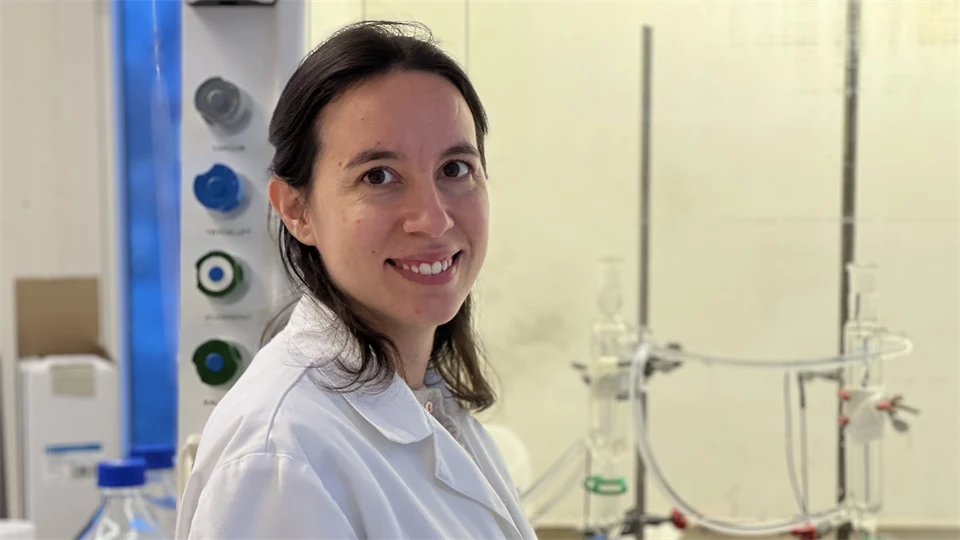
Solange Magalhães has a background in chemistry and colloids from the University of Coimbra in Portugal and has previously worked in industry before returning to academia. During her doctoral studies in chemical engineering, she spent three months at Mid Sweden University through an Erasmus exchange – an experience that made it natural to return when the postdoctoral position within Mission 0 House became available.
“It was impossible not to take the opportunity. The project reflects both my research interests and my commitment to sustainability – developing sustainable materials as well as sustainable processes,” she says.
The goal – a circular process
Her focus is to develop new bio-based flocculants – substances used to purify water in industrial processes by causing microscopic particles, often microplastics, to cluster together so they can be filtered out. The work also involves finding ways to return the removed particles back into production to reduce waste.
“The goal is to create a circular process: purifying the water but also being able to reuse the particles that are filtered out,” she explains.
Mission 0 House seeks to fundamentally rethink how materials and products are designed, built and manufactured. The aim is to eliminate emissions at every stage – from raw material selection to the finished product.
“We look at both the materials and the industrial processes. Zero-emission materials and products such as a car requires the entire chain to be sustainable, not just the final result,” says Solange.
Researchers and industry work closely toghether
The project includes five defined challenge areas where researchers and industry partners work closely together. Solange contributes with her expertise in microplastic removal and bio-based flocculants, an area she has explored since her doctoral studies, and at the same time eliminate the need of fossil-based chemicals with related greenhouse gas emissions.
A central part of Mission 0 House is the so-called Golden Weeks – intensive work weeks held every five weeks, when researchers, engineers and industry representatives gather on site.
“It’s incredibly creative and rewarding. You can present an idea in the morning, and by the end of the day it has become a project plan. It’s truly ‘one for all, all for one’,” says Solange.
The interdisciplinary collaboration allows complex problems to be broken down more quickly and solutions to develop as different perspectives meet.
The biggest challenge in Solange’s part of the project is identifying which bio-based flocculant works best in industrial water treatment processes. Several alternatives are being tested, and the results so far are promising.
“I’m convinced that bio-based flocculants are the future. I know they can work on different types of microparticles,” she says.
"My knowledge grow everyday"
Her research is one of many examples of how Mission 0 House combines materials science, process development and industrial innovation to drive more sustainable solutions.
“I grow in my knowledge every day in this project. Being part of something that can transform an entire industry is fantastic,” says Solange.
“We all work together in the House on one shared task – eliminating greenhouse gas emissions from materials and products. I work particularly closely with Borgstena, who produce automotive textiles, including for Polestar, and whose wastewater forms the basis of my lab tests. The three of us are in contact almost daily, and we are building trust in a unique way - at least for me - in this kind of academia–industry collaboration,” continues Solange.