EB‑FEA – Additive manufacturing of tungsten for future fusion energy within IRS TransTech
EB-FEA is a PhD project within the IRS TransTech research school focusing on additive manufacturing of tungsten components for fusion energy applications. The project combines electron beam powder bed fusion with materials development and characterization in an international collaboration.
IRS TransTech is an international research school at Mid Sweden University aimed at strengthening global collaboration in transformative technologies. Through PhD projects carried out jointly with academic and industrial partners, the research school addresses challenges related to digitalization, advanced materials, and sustainable industrial processes.
Within the research school several doctoral projects explore different technological areas. One of these is EB-FEA, Electron Beam-based manufacturing of tungsten materials for Fusion Energy Applications. The project focuses on developing new manufacturing methods for tungsten components intended for future fusion energy systems.
Tungsten is a material with an extremely high melting point and excellent radiation resistance, making it attractive for applications in nuclear energy and other high-performance environments. However, the material is difficult to process using conventional manufacturing techniques, particularly when complex geometries or thin structures are required.
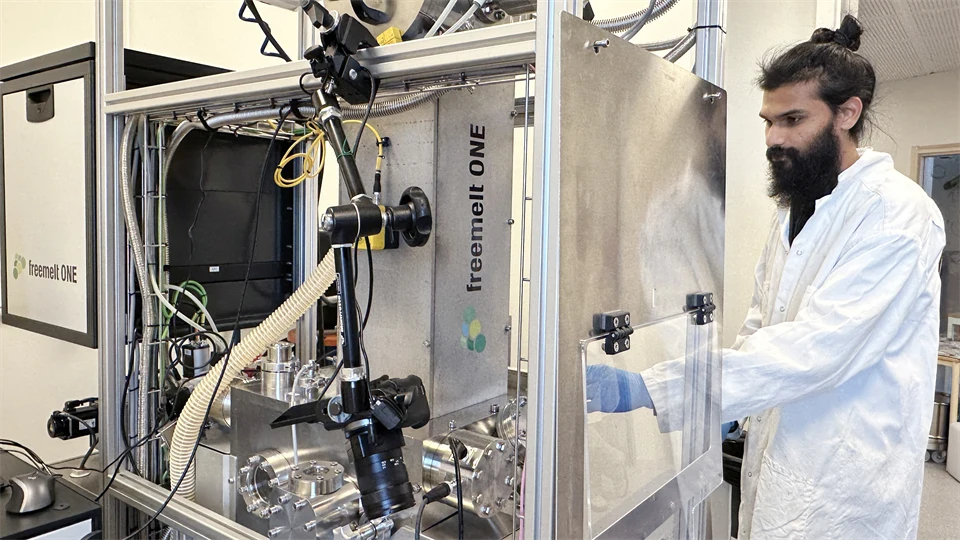
The project therefore investigates the use of electron beam powder bed fusion, PBF-EB, to manufacture tungsten components with high density, high purity, and tailored microstructures. The electron beam process operates in vacuum and at elevated temperatures, which provides favorable conditions for processing refractory materials that are otherwise challenging to manufacture additively.
The research includes both the development of manufacturing strategies and advanced materials characterization of the produced components. The work is carried out in collaboration between Mid Sweden University and the Technical University of Catalonia (UPC), where detailed materials analysis and mechanical characterization are performed. Industrial partners including Sandvik/Wolfram and Freemelt contribute with feedstock materials, technical expertise, and industrial perspectives on future applications.
By developing new approaches for additive manufacturing of tungsten, the project aims to contribute to advanced and sustainable manufacturing solutions for the energy sector, while also opening new research directions in the processing of advanced materials using additive manufacturing.
Facts
Project period
260201—300131
Research centers
Subjects
Project leader

Project members

Funders