Silicon anode batteries
Lithium ion battery anodes can store up to ten times more energy when silicon is used as active material.
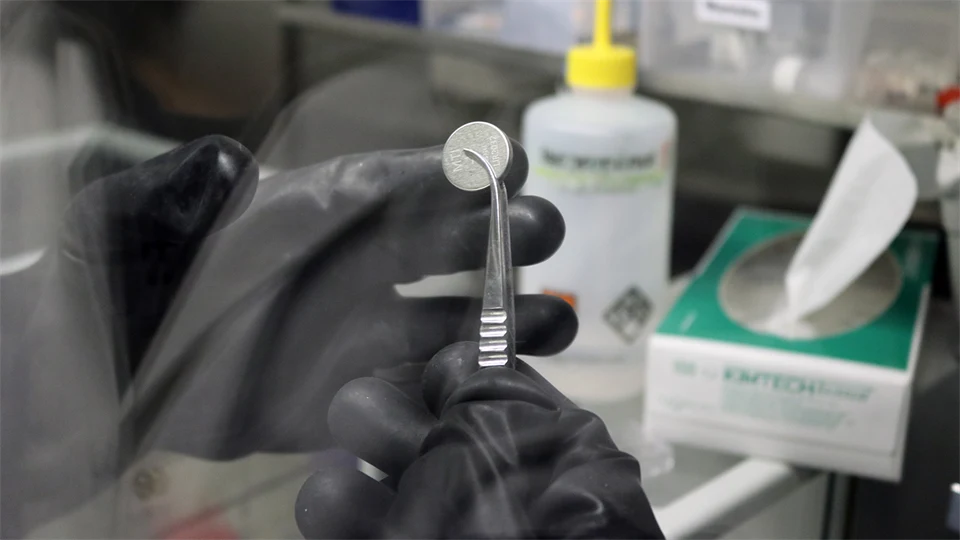
The graphitic anode in lithium-ion batteries utilize intercalation as storage mechanism. i.e. the lithium ions are stored between single graphene layers in graphite during charging. Much research and development around the world is devoted towards introducing silicon in the anode, since silicon can form phases with lithium and thereby store up to ten times more lithium ions as compared to graphite. However, during lithiation (silicon picks up lithium during battery charging) and delithiation (lithium leaves silicon during discharging), the silicon particles crack due to mechanical stress, and cease to contribute to the energy storage capacity of the battery.
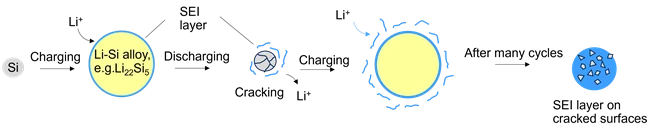
Figure. A silicon particle repeatedly picks up and releases lithium ions, causing the silicon particle to crack. SEI stands for Solid Electrolyte Interface. SEI is an ion conductive layer formed during the first charge-discharge cycle(s).
There are ways to avoid cracking of silicon particles during charging and discharging of the batteries. We conduct research on two methods: i) production and usage of silicon nano particles that are so small that they do not crack during lithiation and delithiation ii) production and usage of porous silicon particles that provide voids for the silicon-lithium phases to expand and contract during lithiation and delithiation.