Gustav Lidén studies democracy in miniature
When Gustav Lidén is inaugurated as Professor of Political Science at Mid Sweden University, it is the culmination of an academic journey that began with an interest in social issues. Today, he researches how society is governed at the local level and what it delivers to its citizens.
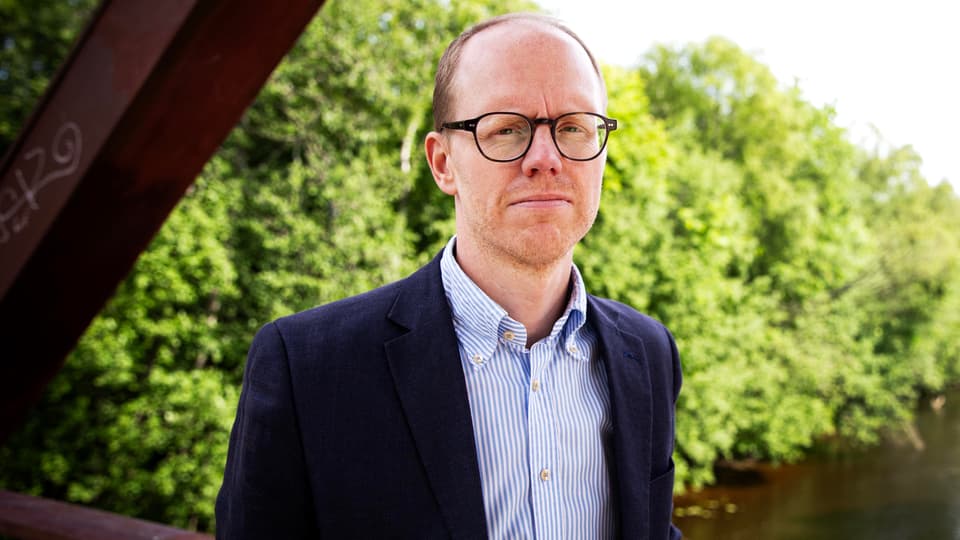
At the beginning of October, Gustav Lidén will be inaugurated as professor of political science during the Academic Ceremony in Sundsvall. However, the path to get there has not been laid out from the beginning.
"It has never really been a conscious plan. I started studying political science because of my interest in social issues, but I really had no idea what the scientific subject as such entailed," he says.
Municipalities are at the centre
Gustav grew up in Söråker outside Sundsvall and graduated from the European Programme at Mid Sweden University in 2006. This was followed by a licentiate degree from Åbo Akademi University and later an externally funded doctoral position at Mid Sweden University, graduating in 2011. Since then, he has been employed at the university.
Today, it is the municipalities that are at the centre of his research.
"I study democratic systems in miniature, namely municipalities. I am interested in how they are governed and what services they deliver to their citizens.
By studying municipalities, he can investigate how democracy works in practice and how political decisions affect people's everyday lives. His research largely involves comparing municipalities with each other, and he looks in particular at areas such as welfare and migration, but also how municipalities use digitalisation tools. At a time when democratic institutions are being challenged in several parts of the world, Gustav Lidén sees local democracy as more important than ever.
What worries you most in today's social development?
"I am worried as liberal democracy is under severe pressure and is in decline internationally. This is also noticeable in studies of municipalities where there are political representatives nowadays who do not accept the rules of democracy. Another example is how the administration, which in Sweden has traditionally enjoyed important independence, is facing a tougher political control where expertise is not ascribed the same importance as before.
Assignments as director of studies and visiting professor attract
In addition to his research, Gustav has been director of doctoral studies at the HUV Faculty since 2022, a position that he describes as particularly meaningful.
"It has been meaningful work to work to support doctoral students and work to improve their conditions.
Over the years, he has also had the opportunity to be a visiting researcher in Spain, Germany and Finland. The experiences have provided both new perspectives and memories for life.
"It has been very educational to live and work in another country for a while and to live your everyday life there. I have also had the opportunity to bring my family with me and it has been fun adventures. Of course, it has also been meaningful from a professional perspective and created important contacts.
Many interests outside research
Gustav sees becoming a professor primarily as a personal responsibility rather than a change in who he is.
"Mostly it's about the fact that I'm going to set other expectations of myself.
At the same time, work has been a big part of my life. Maybe too big a part.
"Sometimes I think that it has probably taken a toll on my family and other interests. The older I get, the more aware I have become of this and therefore try to plan for a more balanced existence.
He finds the balance in the family; his wife and their nine-year-old daughter. They live in a house outside Sundsvall, and they also like to stay at the summer house, which is an old family farm in Gästrikland.
"I like to read, visit museums, go to the theatre and concerts. I'm probably quite broad in my interests.
What do you do when you need new energy or inspiration?
"I go for a run or am out in nature.
When do you feel like you've had a really good day at work?
"I value the collegial work very much, to be able to work together on a task. But I can also really appreciate having a day that is not disturbed by any meetings or anything else to fully focus on my own research problems.
More about the Academic Ceremony
Read more about Gustav Lidén's inaugural lecture
Contact
