Disputation i Elektronik med Meng Jiang
Välkommen till disputation i Elektronik med Meng Jiang som kommer att presentera sin avhandling "Measurement Quality in Acoustic Sensing with Microphones: From Indoor Localization to Heart Sound Classification".
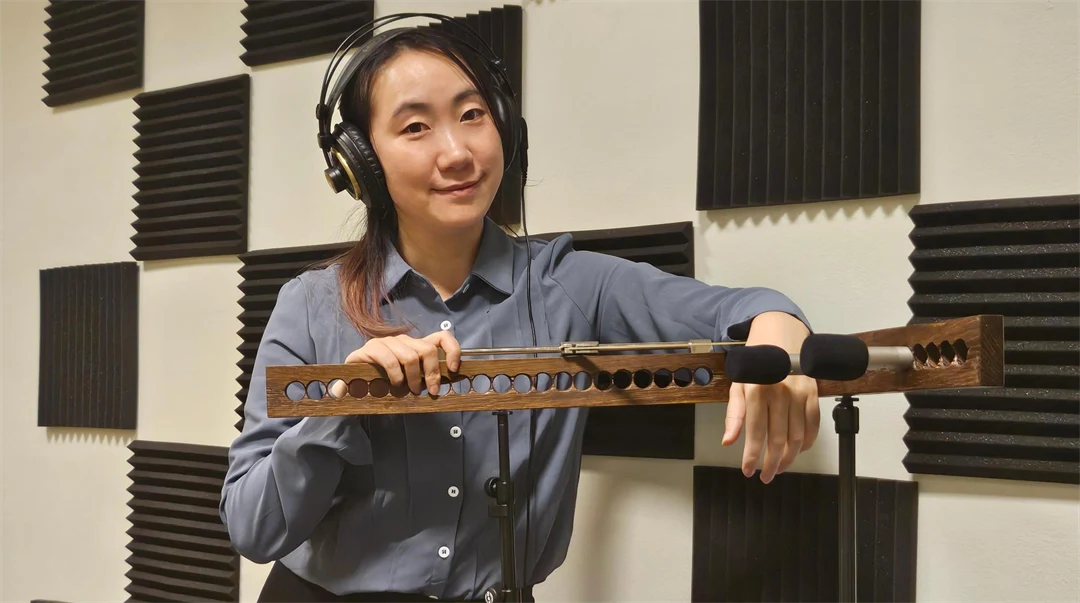
Datum: 25 februari 2026
Tid: 09:00
Plats: Campus Sundsvall, M108, hus M samt online via Zoom och Youtube.
Doktorsavhandling: "Measurement Quality in Acoustic Sensing with Microphones: From Indoor Localization to Heart Sound Classification"
Respondent: Meng Jiang
Handledare och ordförande: Docent Göran Thungström, Mittuniversitetet
Biträdande handledare: Prof. Mårten Sjöström, Mittuniversitetet
Opponent: Professor Domenico Capriglione, University of Cassino and Southern Lazio, Italien
Betygsnämnd:
Docent Vincenzo Paciella, universitetet i Salerno, Italien
Docent Sebastian Bader, Mittuniversitetet
Professor Maria Lindén, Mälardalens universitet
Reserv: Professor Bengt Oelmann, Mittuniversitetet
Abstract (in English)
This thesis investigates how measurement design shapes acoustic source localization and classification, with a focus on the interplay between array geometry, device characteristics, and modern signal processing and deep learning. The work is motivated by a persistent gap between theoretically well-understood methods and the practical realities of indoor positioning and biomedical auscultation, where sensor variability, reverberation, and limited control over operating conditions often dominate performance. The overarching aim is to understand how measurement quality in microphone-based sensing constrains and enables what can be inferred from sound under real-world noise, by treating microphones, arrays, and recording protocols as design variables rather than static background assumptions.
Six studies (P1–P6 refer to the list of papers) are presented. The first line of work concerns acoustic fingerprinting. P1 examines how far a single microphone can exploit ambient noise for indoor “silent” object localization, highlighting both the appeal of zero-emission fingerprints and their sensitivity to day-to-day room changes. P6 revisits fingerprinting with active excitation, using exponential sine sweeps and a four-microphone array feeding a convolutional neural network. The comparison between P1 and P6 shows how moving from uncontrolled ambient sound to controlled probing and array-based features improves robustness. Together, they characterize a practical design space for silent object localization, from simple cross-correlation baselines to array-aided deep learning.
The second line of work addresses direction-of-arrival (DoA) estimation with microphone arrays. P2 compares several planar layouts and microphone directivities in a controlled room, using a representative high-resolution DoA estimator to isolate how geometry and sensor pattern affect accuracy and robustness in realistic indoor conditions. P3 focuses on a six-channel uniform circular array and a coherent wideband pipeline, showing that circular-harmonic focusing can retain MUSIC-level resolution while keeping computational demands compatible with embedded implementations. These studies map how established methods behave when constrained by physically small arrays and practical sensor choices, clarifying when geometry or processing is the main bottleneck.
A third line of work turns to biomedical acoustic classification. P4 evaluates a four-channel electronic stethoscope prototype that combines delay-and-sum beamforming and matched filtering for heart-sound segmentation before classification. Working with a limited and clinically constrained dataset, the study illustrates how a realistic multi-channel auscultation setup can increase segment quality and support distinguish normal and abnormal sound for murmur detection. Finally, the thesis examines measurement quality more generally. P5 introduces a measurement quality pipeline that uses existing recordings to extrapolate the benefit of future system upgrades. By fixing a pretrained CNN and synthetically degrading current data to different SNR levels, the study emulates the performance of improved setups, providing a basis for deciding whether it is worthwhile to invest in new measurements and a full round of model retraining and tuning. These results underline that model architecture and measurement quality jointly determine performance, and that metrological upgrades can sometimes deliver rich information without retraining.
Overall, the thesis contributes a set of measurement-driven case studies that make explicit how arrays, excitation signals, and device responses constrain what localization and classification algorithms can realistically achieve. The outcomes include practical recipes for acoustic fingerprinting, design reference points for compact array configurations in indoor DoA tasks, an experimentally grounded path toward reproducible multi-channel auscultation, and empirical guidelines for anticipating how SNR and device variability affect pretrained models. Rather than resolving all trade-offs, the work argues for treating measurement design and algorithm choice as coupled problems.
