Disputation i Elektronik med Eiraj Saqib
Välkommen till en disputation i Elektronik med Eiraj Saqib, som kommer att presentera sin avhandling "Bottleneck-Aware Optimization of Distributed CNN Inference for Edge-Cloud IoT Systems".
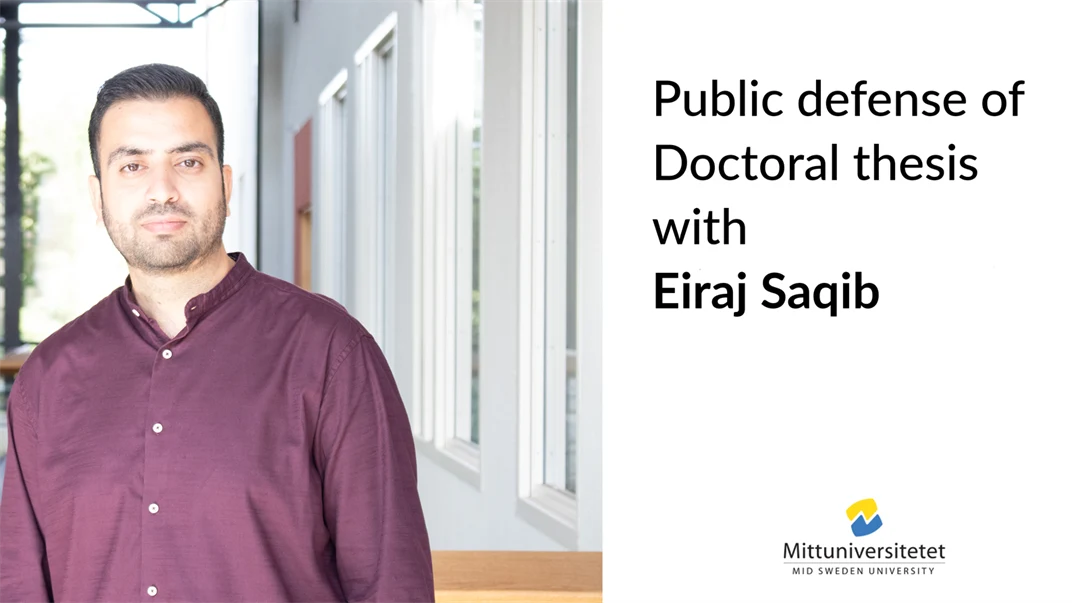
Datum: 9 juni 2026
Tid: 09:00
Plats: Campus Sundsvall, M-huset, sal M108 samt online via Youtube och Zoom.
Doktorsavhandling: Bottleneck-Aware Optimization of Distributed CNN Inference for Edge-Cloud IoT Systems
Respondent: Eiraj Saqib
Handledare och ordförande: Professor Mattias O´Nils, Mittuniversitetet och Lektor Irida Shallari, Mittuniversitetet.
Opponent: Professor Holger Fröning, Heidelberg University, Tyskland
Betygsnämnd:
Professor Slawomir Nowaczyk, Högskolan i Halmstad
Professor Giandomenico Licciardo, University of Salerno
Docent Qing He, Mittuniversitetet
Reserv: Docent Johan Sidén, Mittuniversitetet
Abstract (english)
The proliferation of the Internet of Things (IoT) necessitates deploying Deep Learning (DL) models, specifically Convolu[1]tional Neural Networks (CNNs), on resource constrained edge devices. However, the high computational and memory de[1]mands of CNNs often exceed the capabilities of IoT nodes, while traditional cloud offloading suffers from latency and bandwidth limitations. This thesis proposes a comprehensive framework for Split Computing, enabling efficient distributed inference by partitioning CNNs between IoT nodes and edge servers.
The core contribution is a bottleneck-aware feature com[1]pression mechanism designed to minimize data traffic at the partition point. The research demonstrates that combining partitioning with extreme quantization (down to 1-bit) and compression reduces data transmission by over 99% with min[1]imal accuracy loss. This approach is augmented by a novel hybrid structured pruning criterion, utilizing L2-norm magni[1]tude and entropy, which selectively removes non informative channels to achieve significant speed-ups and energy savings compared to baseline execution modes.
To address quantization induced accuracy degradation, the thesis introduces Time-dependent Clustering Loss (TCL), a regularization technique that clusters activations during train[1]ing to ensure robustness against extreme quantization errors.
Furthermore, the complex selection of partition points, compres[1]sion ratios, and quantization levels is automated via CO-NAS (Compression Optimization, and Neural Architecture Search), a differentiable architecture search framework that efficiently discovers Pareto-optimal configurations.
Validated on diverse hardware platforms (e.g., Raspberry Pi, NVIDIA Jetson) and standard datasets (CIFAR-100, Tiny[1]ImageNet), these methodologies establish a robust pathway for Edge Intelligence. By unifying partitioning, quantization, pruning, and automated search, this work provides a scalable solution for deploying high performance vision models in resource constrained IoT environments.