
av
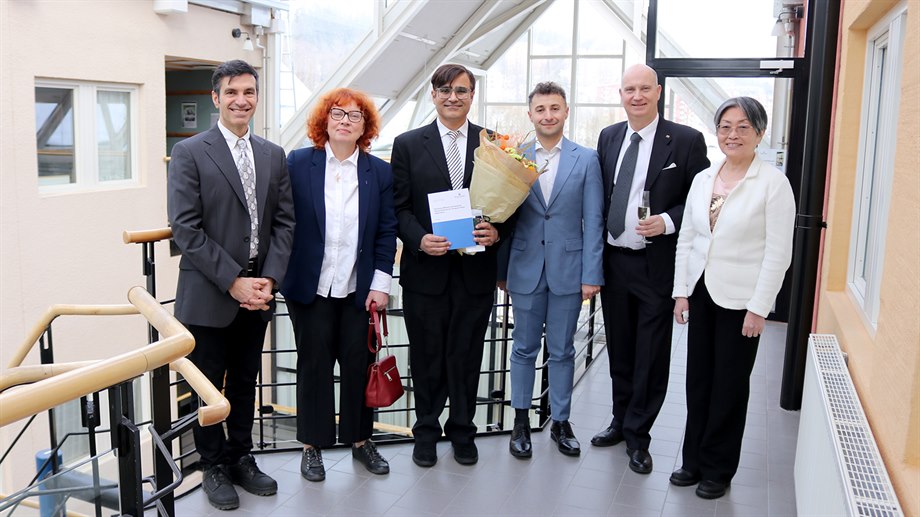
Den 27 februari presenterade och försvarade Ali Hassan framgångsrikt sin doktorsavhandling "Parameter-Efficient Convolutional Neural Networks for Computer Vision Applications" och kan nu kalla sig doktor i datateknik.

Inbjuden opponent var professor Jenny Benois Pineau vid Université de Bordeaux i Frankrike, som tillsammans med betygsnämnden granskade avhandlingen. I betygsnämnden deltog docent Djamila Aouada, docent Alexandros Sopasakis vid Luxemburgs universitet, docent Enzo Tartaglione vid Lunds universitet, Telecom-Paris, Frankrike.
Ali Hassans avhandling utvecklar parameter-effektiva CNN-arkitekturer för datorseende. Genom manuell optimering och förbättrade DARTS-metoder minskade han modellparametrarna med upp till 76 % samtidigt som noggrannheten bibehölls eller förbättrades, vilket möjliggjorde realtidsimplementering av AI i resursbegränsade system.
Ali Hassans doktorandresa finansierades som en del av Plenoptima, ett europeiskt samarbete med forskare och partnerorganisationer i ett innovativt utbildningsnätverk. Målet för Plenoptima är att utveckla ett tvärvetenskapligt angreppssätt på plenoptisk avbildning. Detta innebär nu att Ali har en dubbelexamen från både Mittuniversitetet och Tammerfors universitet i Finland. Handledare för hans arbete var professor Mårten Sjöström, professor Karen Eguiazarian och professor Tingting Zhang.
Vi gratulerar Ali till hans fantastiska arbete och hans nya titel som doktor i datateknik.
Recent advancements in convolutional neural networks (CNNs) have made significant improvements in computer vision tasks, such as image classification (identifying objects), fire segmentation (identifying pixels within fire regions), and light field disparity estimation (predicting pixel-wise disparities from light field data). These tasks play a vital role in many real-world computer vision applications, such as autonomous vehicles, emergency response, and immersive multimedia systems. However, state-of-the-art CNNs remain computationally expensive, requiring millions of parameters and substantial hardware resources, which limits their deployment inreal-time and resource-constrained environments.
The overall aim of this thesis is to investigate architecture optimization strategies to propose parameter-efficient CNN architectures that require fewer parameters while maintaining competitive performance, thereby improving their practicality for deployment on resource-constrained devices. To achieve this, two architecture optimization approaches were employed: (i) manual architecture optimization (MAO), where convolutional feature extraction modules were optimized using Depthwise Separable Convolution and Mixed Convolution; and (ii) differentiable architecture search (DARTS), where the search strategy was enhanced to address architectural limitations in existing methods and to automatically discover lightweight, highperforming CNN architectures.
Although MAO and DARTS optimization approaches have been widely applied to image classification, their impact on complex computer vision tasks such as fire segmentation and light field disparity estimation remains underexplored. To address this research gap, this thesis introduces two DARTS search frameworks together with seven parameter-efficient CNN architectures, developed through both MAOand DARTS approaches. These approaches were systematically evaluated across publicly available benchmark datasets across image classification, fire segmentation, and light field disparity estimation.
The experimental results demonstrate that these architecture optimization methods consistently reduce parameter count while improving accuracy across fire segmentation and light-field disparity estimation tasks, demonstrating both the effectiveness and generality of the proposed optimization methods. More specifically, MAO-based architectures require up to 76% fewer parameters while maintaining comparable accuracy. In contrast, architectures discovered by the optimized DARTS frameworks require up to 71% fewer parameters and deliver improved accuracy while significantly reducing search cost. These parameter reductions further decrease computational cost (floating-point operations), inference time, and storage requirements, enabling deployment in real-time and resource-constrained environments.
In summary, this work establishes validated methodologies to design parameter efficient CNN architectures. It highlights their potential for deployment in realworld applications and resource-constrained environments, such as embedded fire detection systems, autonomous vehicles, and immersive media applications. Theimpact extends to the research community by minimizing computational resource and search time needed to discover effective architectures; to industry by enabling real-time processing on embedded systems; and to society by making advanced artificial intelligence applications more accessible, efficient, and privacy-preserving through on-device processing of visual data for decision making.
Sidan uppdaterades 2026-03-03