
av
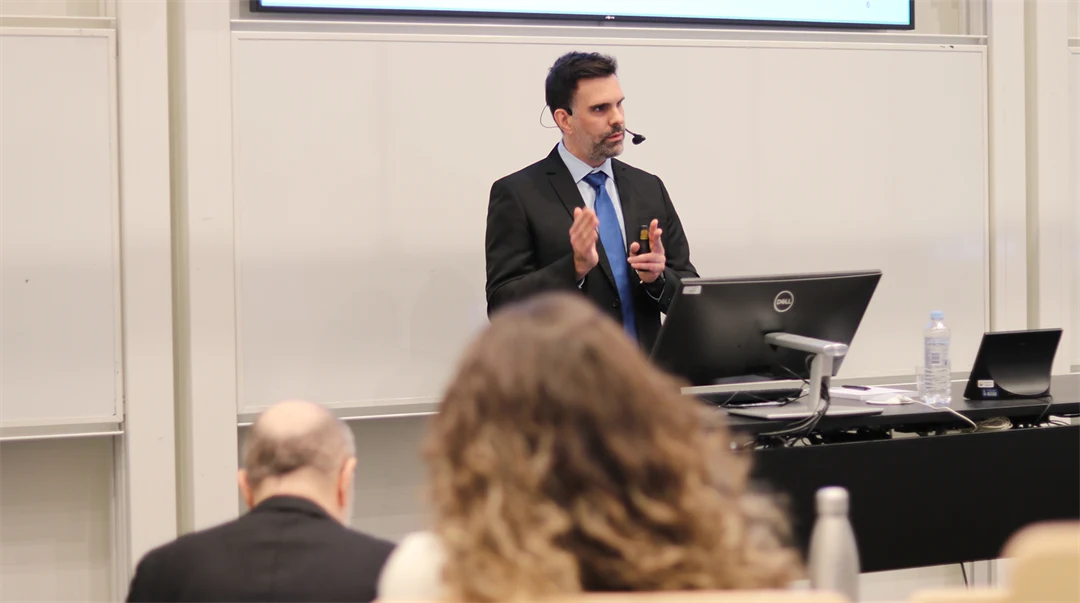
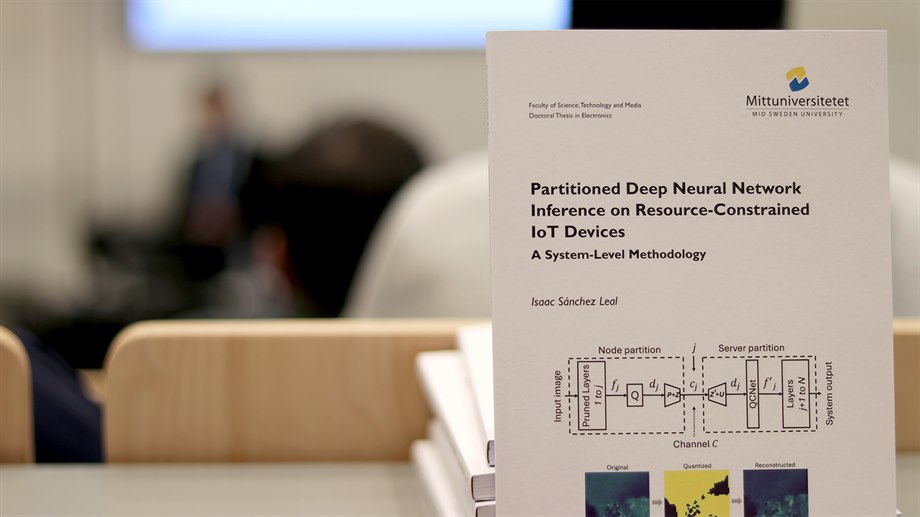
Den 18 februari försvarade Isaac Sánchez Leal framgångsrikt sin doktorsavhandling om partitionerad inferens av djupa neurala nätverk för resursbegränsade IoT-enheter. Hans arbete presenterar en systemnivåmetodik som möjliggör effektiv och noggrann AI-körning på batteridrivna edge-enheter.

Opponent på avhandlingen var professor Johan Lilius från Åbo Akademi i Finland. Tillsammans med betygskommittén bestående av professor Per Gunnar Kjeldsberg, Norges teknisk-naturvitenskapelige universitet (NTNU), docent Oscar Gustafsson, Linköpings universitet, och professor Bonavolontà Francesco, Università degli Studi di Napoli Federico II (UniNa) / University of Neapel Federico II, granskades och godkändes arbetet noggrant.
Avhandlingen handleddes av professor Mattias O'Nils och biträdande handledare var Dr. Irida Shallari vid Mittuniversitetet
Med denna prestation kan Isaac nu stolt kalla sig doktor i elektronik.
The proliferation of the Internet of Things (IoT) has driven the deployment of Deep Learning models on constrained edge devices. However, a fundamental conflict exists between the computational demands of Deep Neural Networks (DNNs) and the strict energy and processing limits of battery-operated nodes. While intelligence partitioning offers a potential solution by offloading computation to a server, practical deployment is hindered by the structural barrier of modern DNNs, which are characterized by intensive early-layer computation and intermediate data expansion, creating critical bottlenecks in distributed environments. This thesis presents a system-level methodology to bridge the gap between algorithmic demands and hardware constraints.
The research begins by identifying the governing parameters of system efficiency through a systematic analysis method and a Design Space Exploration (DSE) method. Based on these core determinants, a co-design strategy is introduced to overcome the structural barrier to partitioning. By synergistically combining model- and data-level transformations, this approach induces efficiency at potential partition points, significantly reducing node energy consumption and system latency. Finally, the thesis proposes an accuracy recovery method to effectively decouple node efficiency from application accuracy. By shifting the paradigm from loss mitigation to compensation, this reconstruction engine ensures that performance is maintained relative to the baseline accuracy even under extreme optimization actions.
In summary, this thesis establishes a system-level methodology for the efficient partitioning of DNNs. It demonstrates that by operationalizing the presented formal design workflow, it is possible to exploit the capabilities of resource-unconstrained servers to maximize node battery life and minimize system response time. This work lays the foundation for ubiquitous intelligence, enabling the deployment of advanced AI on resource-limited hardware by transforming the structural limitations of DNNs into opportunities for distributed efficiency.
av
av

av
av
Sidan uppdaterades 2026-03-03