Tourism PhD student Anke Peters attends UN Global Biodiversity Conference
When the world gathered in Armenia from 19-30 October 2026 for the UN Biodiversity Conference, Anke Peters, PhD student in Tourism Studies at ETOUR, was among the participants. She returned with new perspectives and a commitment to highlighting the role of tourism in biodiversity conservation.
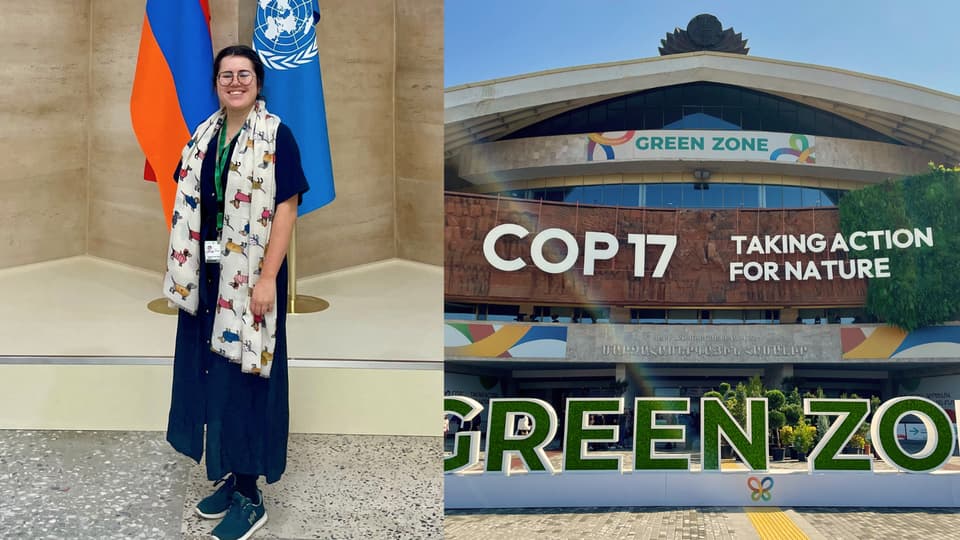
Over two intensive weeks in October, Anke Peters attended COP17, the UN's global biodiversity conference in Yerevan, Armenia, as a delegate. The conference brought together policymakers, researchers, international organisations, representatives of Indigenous Peoples and many others from around the world.
The issues discussed at the conference are closely connected to Anke's own research. Her doctoral thesis examines the relationship between tourism and biodiversity. As a board member of the Nordic Youth Biodiversity Network, she had the opportunity to participate in the UN conference.
– Biodiversity is an issue very close to my heart, and it is also the focus of my thesis. I went to Yerevan to share insights from my research, connect with other researchers and advocate for greater youth inclusion in efforts to promote and conserve biodiversity, says Anke.
Tourism was missing from the discussions
The conference gave Anke new perspectives on how biodiversity work is carried out at the international level. One of her most important takeaways concerned the role of tourism in global biodiversity efforts. Despite the close relationship between tourism and biodiversity, she felt that tourism received limited attention in the discussions.
– It was clear that tourism-related issues are largely absent from biodiversity discussions at this level, even though the two are closely intertwined. This has made me even more motivated to highlight and raise awareness of the links between tourism and biodiversity in the future, says Anke.
Another insight concerned the arguments used to justify biodiversity conservation. During the conference, discussions often focused on the resources and economic benefits that nature provides. Anke felt that many other, less tangible and more relational values of biodiversity did not find appropriate consideration in the discussions.
– I do understand, however, that this economic focus arises out of an urgency to mobilise funding for biodiversity conservation. Currently, for every dollar invested in protecting nature, around 30 dollars go towards activities that harm it, she says.
The core of COP17 was the negotiations between country representatives. Alongside these, presentations, panel discussions, workshops and other side events were organised, covering a wide range of biodiversity-related topics.
– It was high-level UN negotiations, a large exhibition and a transdisciplinary conference, all happening at the same time. Participants included politicians, researchers, conservation practitioners, representatives of Indigenous Peoples and many others, says Anke, who tried to follow different negotiations and attend as many events as possible.
Two moments that made a lasting impression
Two experiences made a particularly strong impression on Anke. The first was walking into the large conference venue for the first time. The flags of UN member states were flying and visitors were greeted by the conference slogan "Taking action for nature".
– Just being there made me feel both proud and privileged to be part of it, says Anke.
The second experience that stayed with her was the launch of the first global conservation strategy for fungi. She was surprised that such a strategy had not existed before and describes the moment as both significant and historic.
– Everyone in the room, from politicians and researchers to representatives of Indigenous Peoples, was excited and hopeful that the consideration of fungi will pave the way for more integrated approaches to biodiversiy conservation.
COP17 also marked the first global review of progress towards the Kunming-Montreal Global Biodiversity Framework. The framework includes 23 targets to be achieved by 2030, and the review showed that the world is not on track to meet them.
One important outcome of the conference was the Yerevan Pathway, which sets out clear priorities for the period leading up to 2030. These include reducing subsidies that harm nature, aligning national budgets and economic decision-making with the framework, and strengthening implementation and monitoring.
Biodiversity needs to be integrated across sectors
It remains to be seen what the decisions made at COP17 will mean in practice. For Anke, one important conclusion is that biodiversity cannot be the responsibility of environment ministries alone.
– Biodiversity perspectives need to be integrated across other sectors of society, such as finance, infrastructure and agriculture. And, from my perspective, tourism and the visitor economy, says Anke.
The next UN Biodiversity Conference, COP18, will be held in Ecuador in two years. Countries will once again come together to review global progress.
About ETOUR
ETOUR is Sweden’s leading tourism research centre and one of Europe’s largest research environments dedicated to tourism. We develop and share scientific knowledge about tourism and travel, with a particular focus on sustainable destination development.
We conduct research and provide education in close dialogue and collaboration with stakeholders across the tourism industry. Our team comprises around 40 members from a wide range of academic disciplines, including some of the world’s most distinguished tourism researchers.
What gives our work meaning is the difference it makes to others, and the momentum it creates. We provide the tourism industry with knowledge and insights that have previously been lacking. Knowledge that helps stakeholders and decision-makers navigate challenges, strengthens development initiatives, informs public debate and provides a foundation for policymaking.
We are driven by curiosity and a genuine passion for understanding tourism in depth: its power, its potential and its interplay with other areas of society. Visit ETOUR's website to learn more about what we do.
For contact or questions