Circular functional fibers for safe and sustainable food packaging and hygiene materials
FIBER-CIRC develops circular uses for CTMP-derived fine fiber fractions in food packaging and hygiene materials. The project strengthens Mid Sweden University’s research in sustainable forest-based materials and connects FSCN’s CTMP expertise with research at North Carolina State University, USA.
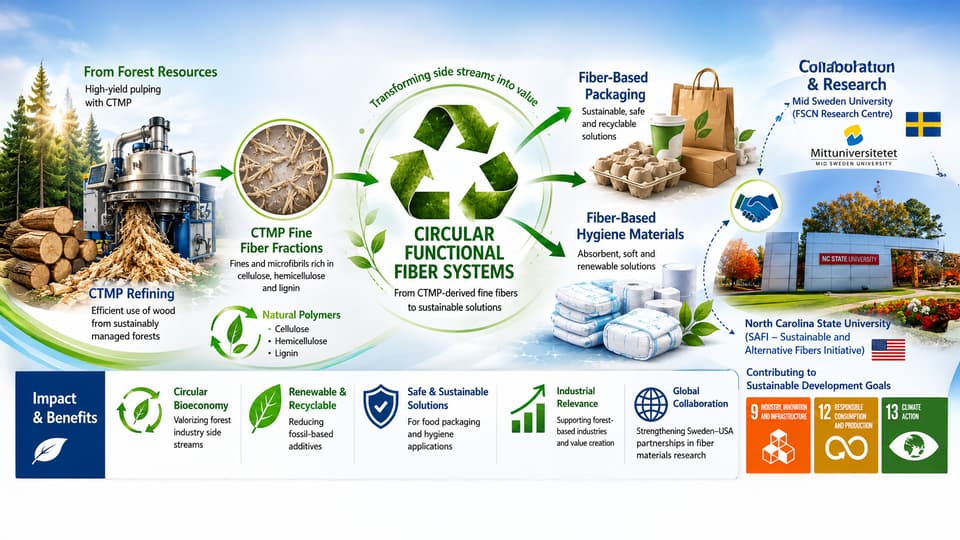
The transition from fossil-based materials to renewable and recyclable alternatives is creating new opportunities for the forest-based materials sector. Food packaging and hygiene products are two important application areas where fiber-based materials can replace fossil-based components, but many current systems still depend on synthetic binders, wet-strength additives, or other chemical treatments to achieve sufficient strength, moisture resistance, or functional performance.
FIBER-CIRC addresses this challenge by investigating how fine fiber fractions from chemithermomechanical pulp, CTMP, can be upgraded into multifunctional fiber components. CTMP fines and fiber fragments contain cellulose, hemicellulose, and lignin, and have a large surface area and reactive surface chemistry. These properties make them interesting not only for improving fiber–fiber bonding, but also for controlling liquid interaction, structural stability, and absorbency-related performance in fiber networks.
The project, therefore, moves beyond a narrow adhesive concept. Instead, it explores CTMP-derived fines as a broader platform for circular fiber-material design. In food packaging, the fine fractions may improve bonding and structural integrity without relying on fossil-derived additives. In hygiene-related materials, the same fiber fractions may influence absorbency, liquid distribution, and network formation, properties that are central for absorbent products, wipes, and other fiber-based hygiene systems.
Experimental work will be carried out at Mid Sweden University within the FSCN Research Center, where research on CTMP processes, fiber chemistry, and forest-based materials is well established. The project will study how fine morphology, surface properties, and dispersion behavior affect material performance in model packaging and hygiene systems. The aim is to identify processing strategies that better utilize currently underutilized fiber fractions from CTMP production.
An important part of FIBER-CIRC is the collaboration with North Carolina State University, USA, particularly through the Sustainable and Alternative Fibers Initiative, SAFI. The collaboration will support joint evaluation of fiber functionality in hygiene-related systems and strengthen the connection between Swedish CTMP research and international research on sustainable fiber materials.
The project is expected to generate new knowledge on how CTMP-derived fiber fractions can be used as circular material components in food packaging and hygiene applications. The results can contribute to higher-value use of forest-industry side streams, reduced dependence on fossil-based additives, and new opportunities for companies producing CTMP and other fiber-based materials.
Facts
Project period
260801—270731
Research centers
Research groups
Project leader

Project members