NEXRAM, Next Generation Manufacturing of Refractory Metals Using Artificial Intelligence and Additive Manufacturing
The NEXRAM project develops new methods for additive manufacturing of refractory metals such as tungsten. By combining sensors, real time monitoring, and machine learning, the manufacturing process will be optimized to improve quality, reliability, and sustainability.
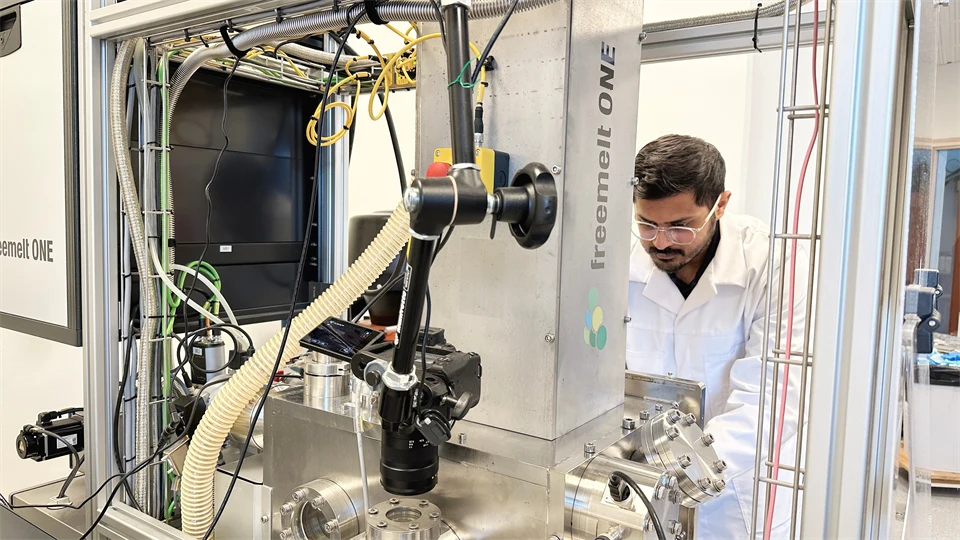
Additive manufacturing (AM) enables the production of metal components with complex geometries that are difficult or impossible to manufacture using conventional methods. This is particularly relevant for refractory metals such as tungsten and zirconium, which are used in applications involving extremely high temperatures, for example in nuclear energy, fusion technology, and medical devices. At the same time, these materials are very challenging to process using traditional manufacturing techniques due to their high melting points, hardness, and sensitivity to oxidation.
Electron beam powder bed fusion, PBF-EB, offers a promising route for manufacturing such materials. The process operates at high temperatures and in vacuum, which reduces the risk of oxidation and can mitigate thermal stresses during manufacturing. Despite these advantages, significant challenges remain, particularly in maintaining a stable heat balance during the build process. Excessive energy input can cause swelling or distortion, while insufficient energy may result in porosity and incomplete densification.
The objective of the NEXRAM project is to develop new manufacturing strategies for refractory metals by integrating advanced process monitoring and artificial intelligence into additive manufacturing. During the build process, sensors such as backscatter detectors, optical imaging systems, and pyrometry will be used to collect extensive data on temperature distribution, layer quality, and defect formation. These data will be analyzed using machine learning methods to develop models capable of predicting and controlling the evolution of the process.
In the long term, the developed models will be integrated into the manufacturing system to enable real time adjustments of process parameters during the build process. Such a feedback system can improve material quality, increase manufacturing reliability, and reduce the need for post processing or part rejection. The project therefore contributes to making additive manufacturing more industrially competitive and more resource efficient.
The project is carried out in collaboration between researchers in mechanical engineering and electrical engineering (STC) at Mid Sweden University, with the aim of strengthening the connection between digitalization, sensor technology, and advanced materials processing within additive manufacturing.
Facts
Project period
250901—290930
Research centers
Departments
Project leader

Project members


Funders