
CER affiliated employee Tarek Rana writes on the CER blog about how international collaboration has become a foundational pillar of high-quality account in an increasingly complex and interconnected world.
Contemporary challenges, such as ESG, climate change, digital transformation, and the governance of algorithmic systems, are inherently transnational and multidisciplinary. Addressing these challenges requires not only methodological rigor but also the integration of diverse institutional perspectives, theoretical traditions, and empirical contexts. International collaboration, therefore, enables scholars to move beyond context-bound insights toward more generalizable, impactful, and policy-relevant contributions.
From a research standpoint, collaboration across borders enhances analytical depth and theoretical innovation. It facilitates exposure to different regulatory regimes, organisational practices, and socio-political environments, thereby enriching the empirical grounding of research. It also supports the development of novel conceptual frameworks through intellectual exchange and critical dialogue. Equally important, international collaboration plays a vital role in capacity building through doctoral supervision, mentorship, and the co-creation of scholarly communities that sustain long-term research agendas.
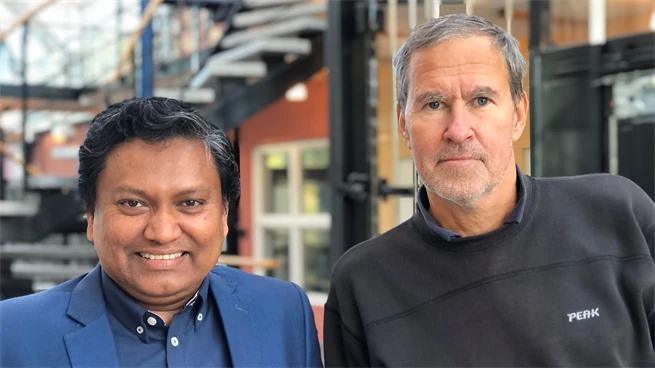
Tarek Rana and Peter Öhman.
My ongoing collaboration with Professor Peter Öhman and the Centre for Research on Economic Relations (CER) at Mid Sweden University provides a strong illustration of these dynamics. This partnership has developed into a sustained and productive research relationship anchored in shared interests in ESG, digital transformation, and public governance. Importantly, it reflects a broader commitment to positioning accounting as a socio-technical and institutional practice that shapes organisational behaviour, public accountability, and societal outcomes.
A defining feature of our collaboration is its thematic coherence and forward-looking orientation. Our joint research with Associate Professor Jan Svanberg from the University of University of Gävle (and a CER-member) has engaged with the transformative impact of artificial intelligence, machine learning and data analytics on accounting and auditing practices. For example, our collaborative work on predictive machine learning and ESG analytics (e.g., Svanberg et al., 2022; Svanberg et al., 2023) examines how advanced analytical tools are reshaping materiality assessments, sustainability performance measurement, and audit processes. These studies contribute to a growing body of literature that interrogates both the opportunities and risks associated with the digitalization of accounting, particularly in relation to transparency, accountability, and decision-making quality.
More recently, our collaboration has extended into examining the implications of AI for auditor judgement and objectivity, including work on automation, time budget pressure, and cognitive biases in audit settings. These projects aim to theorise the limits of automation in professional contexts and to understand how technological systems interact with human judgement—a question of increasing importance in both academic and policy debates.
In terms of scholarly outputs, this collaboration has generated a diverse portfolio of contributions, including journal articles, book chapters, and edited volumes. Notably, we co-edited the Handbook of Big Data and Analytics in Accounting and Auditing, which brings together international scholars to explore the implications of data-driven technologies for accounting practice and research. We have also contributed to sustainability, ESG reporting, and digital transformation, thereby advancing interdisciplinary dialogue across accounting, information systems, and public governance.
Beyond publications, the collaboration has been instrumental in building academic infrastructure and intellectual communities. Through joint seminars, keynote presentations, and workshops at CER and RMIT University, we have created platforms for knowledge exchange and critical engagement. These activities not only disseminate research findings but also foster dialogue among scholars, practitioners, and policymakers. Furthermore, our collaboration has supported doctoral training and mentorship, contributing to the development of early-career researchers working at the intersection of accounting, sustainability, and technology.
The relational dimension of this partnership is equally significant. Sustained collaboration over time has enabled trust, intellectual alignment, and the co-evolution of research agendas. This has allowed us to undertake more ambitious projects, including joint grant applications and the development of new conceptual frameworks that push the boundaries of accounting research.
Looking forward, our collaboration continues to evolve in response to emerging global challenges. Key areas of future research include AI-enabled sustainability assurance, resilience-oriented management control systems, and the governance of digital and cyber risks. These themes underscore the need for accounting research to engage more deeply with issues of uncertainty, complexity, and societal impact.
To this end, international collaboration, exemplified by the partnership with CER, is not simply an academic exercise but a strategic and intellectual necessity. It enables the co-creation of knowledge that is theoretically robust, empirically grounded, and socially relevant. By bridging geographical, institutional, and disciplinary boundaries, such collaborations contribute to advancing accounting as a transformative field capable of addressing the pressing challenges of our time.
Tarek Rana
Associate Professor, RMIT University, Melbourne, Australia

Sidan uppdaterades 2026-04-09
Kommentarer
Ingen har kommenterat än, var den första!