FINE‑GLUE – Development of circular bio‑based adhesives from CTMP fine fractions for fiber‑based packaging applications
FINE-GLUE investigates how underutilized CTMP fine fractions and sludge can be upgraded into water-based bio-adhesives for recyclable fiber-based packaging, enabling a more circular use of side streams from the forest industry.
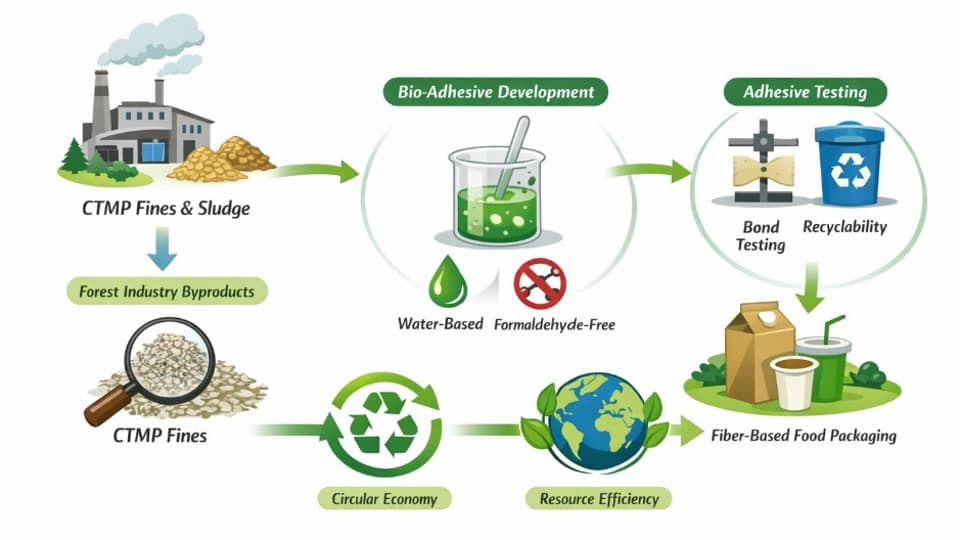
The transition toward sustainable fiber-based packaging requires new adhesive solutions that are renewable, water-based, recyclable, and compatible with existing fiber networks. At the same time, chemithermomechanical pulp (CTMP) production generates large volumes of fines and sludge fractions that remain underutilized despite their high cellulose, hemicellulose, and lignin content.
The FINE-GLUE project explores a circular approach by investigating whether CTMP fines and sludge can be directly upgraded into functional bio-adhesive systems for fiber-based packaging applications. Instead of extracting individual polymers or synthesizing new adhesive components, the project examines whether the intrinsic bonding potential of fine fiber fractions can be used to promote fiber–fiber bonding in simple water-based formulations.
The concept will be evaluated through laboratory-scale formulation and testing. CTMP fines and sludge will be collected from industrial and pilot-scale streams, gently processed, and formulated into adhesive-active dispersions. Bonding performance, moisture behavior, rheological properties, and recyclability will be assessed to determine whether the material can meet basic functional requirements for fiber-based packaging systems.
The project is carried out at Mid Sweden University in collaboration with the BioGlue Center at SLU, Uppsala. By transforming forest-industry side streams into value-added adhesive materials, FINE-GLUE aims to support resource-efficient forest utilization and lay the foundation for future, larger-scale research and industrial collaboration in sustainable bio-based packaging.
This project is funded by the C.F. Lundström Foundation.
Facts
Project period
260601—270131
Research centers
Subjects
Research groups
Project leader

Project members