Symposium for Early Career Researchers Working with Indigenous Issues 2026
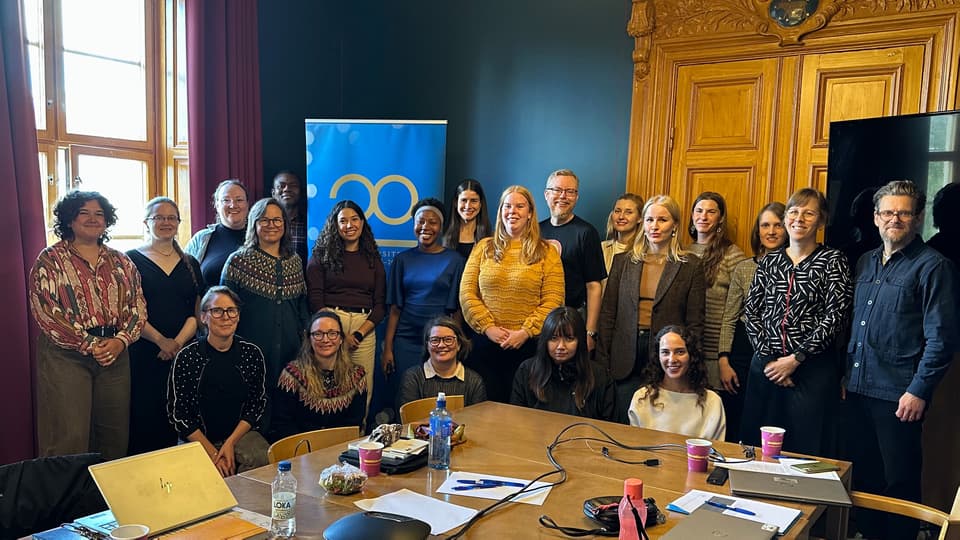
On October 27-28 2026, we are arranging the Symposium for Early Career Researchers Working with Indigenous Issues at Gaskeuniversiteete (Mid Sweden University). For two days, researchers gather in Staare (Östersund) to share their research, exchange experiences and find collaborations.
Date: 27-28 October 2026
Location: Gaskeuniversiteete (Mid Sweden University) in Östersund, Sweden.
About the symposium
On 27–28 October, Gaskeuniversiteete (Mid Sweden University) will host the second symposium for early-career researchers working with Indigenous issues. The event takes place in Staare (Östersund) and is organized by the subject of law at Mid Sweden University.
The Symposium for Early Career Researchers Working with Indigenous Issues 2026 aims to create a supportive and engaging environment where early-career researchers can share experiences, discuss common challenges, and make connections for future collaborations. It also aims to highlight ongoing research at Gaskeuniversiteete concerning Indigenous issues, especially in relation to the local Saami population, and to show the work at Gaaltije – Saami cultural centre and museum.
High Demand: More Applications Than Available Spots
We welcomed applications from early career researchers working on Indigenous issues. This includes doctoral candidates, postdoctoral researchers and master's students. Around fifty applications were submitted by early-career researchers seeking to participate in this year’s symposium, and 14 researchers have been selected. This year’s participants come from Sweden, Norway, Finland, Belgium, and Denmark. In total, approximately 30 people will attend the symposium, including the organizers and speakers.
Program
The program includes presentations by a number of keynote speakers as well as other invited speakers, such as:
- Hanna-Máret Outakoski, Professor of Saami Language Education at the Saami University of Applied Sciences (Saami allaskuvla).
- Kamrul Hossain, Research Professor and Director of the Northern Institute for Environmental and Minority Law (NIEM), Arctic Centre, University of Lapland.
- Andrey Danilov, representative of the Russian Saami, who was forced to leave Russia in 2022 and applied for political asylum in Norway.
- Andreas Andersson, Associate Professor of Environmental Engineering and Environmental Science at Mid Sweden University.
The participants will also visit Gaaltije, Saami museum, where Jerker Bexelius, Director of Operations, will give a presentation and lecture about the museum's work. In addition, the symposium will include participant presentations, providing an opportunity to present research projects in a constructive and collegial environment.
See the preliminary program and presentations of some of the speakers further down this page.
More about the symposium
The Symposium for Early Career Researchers Working with Indigenous Issues 2026 is funded by the Barents Secretariat and The Lars Hierta Memorial Foundation as well as Stiftelsen Clara Lachmanns fond and Letterstedtska Föreningen. The symposium is part of Mid Sweden University's broader investment in Saami research and education and offers a platform for knowledge exchange, methodological discussions and meetings with representatives from Saami civil society.
Mid Sweden University/Gaskeuniversiteete is the only university located within the South Sámi region of Sweden, and the university is strongly committed to Sámi research and education. The subject of law at the university has several areas of specialization, one of which is Sámi law. The symposium is part of a broader effort to strengthen research and education related to Sámi issues and perspectives.
Programme
October 26, 2026
Participants' arrival and check-in at Hotel Gamla Teatern.
Tuesday 27 October 2026
Location: Room B312 at Gaaskeuniversiteete (Mid Sweden University) in Staare (Östersund)
08:30–08:35 Opening words by the Head of the Subject of Law at Mid Sweden University, Mikael Lundholm
08:35–08:40 Introduction to the symposium organisation and programme
08:40–08:50 Short presentation of symposium participants
08:50–09:10 Camilla Olofsson Bååtas – “Gaskeuniversiteete/Mid Sweden University as a university with a strong focus on Saami research and education”
09:10–09:30 Angelika Sjöstedt – ”The Båskoes Network”
09:30–09:45 Questions and discussion
09:45–10:15 Coffee break
10:15–11:30 Hanna-Máret Outakoski ”Doing research in Indigenous contexts offers unique opportunities but comes with many obligations”
11:30–11:45 Questions and discussion
11:45–13:00 Lunch
13:00–14:15 Kamrul Hossain ”The Rights of Indigenous Peoples under International Human Rights Law with special focus on the Nordic Saami”
14:15–14:30 Questions and discussion
14:30–14:50 Walk to Gaaltije-Saemien museum
14:50–15:50 Jerker Bexelius “Gaaltije-Saemien museum in contemporary Saepmie”
15:50–16:50 Inger-Ann Omma
18:00– Evening symposium dinner at Restaurang Oense
Wednesday 28 October 2026
Location: Room B312 at Gaaskeuniversiteete (Mid Sweden University) in Staare (Östersund)
08:30–09:30 Andrey Danilov “Life After Leaving Russia: Indigenous Peoples’ Rights in Russia Today and Personal Experiences of Cooperation with Researchers”
09:30–09:45 Questions and discussion
09.45–10.45 Andreas Andreasson
10:45–11.00 Questions and discussion
11.00–11:30 Coffee break
11:30–13:00 Presentation of participants’ own projects in two groups (10 minutes per presentation)
13:00–14:15 Lunch
14:15–14:45 Gwendolyne Knight “’Suddenly it happens’? Reflections on transitioning from early career researcher to junior faculty”
14:45–15:15 Mirkka Ollila ”Mapping the disharmonies between legal frameworks and corporate statements in the development process of the Kolmozerskoye lithium deposit”
15:15–15:45 Discussion on future cooperation and closing words
About some of the keynote speakers
Hanna Maarit (Hanna-Máret) Outakoski
Hanna Maarit (Hanna-Máret) Outakoski holds the title of Docent of Sámi languages at Umeå University, Sweden and is at present tenure professor in Sámi language and language didactics at the Sámi University of Applied Sciences in Norway. In her current position at SUAS, Outakoski works within the Sámi teacher education that is the only teacher education that is based on Sámi values and is taught fully in Sámi language. Outakoski is a member of the Indigenous Sámi community and originates from Northern Finland. She teaches and does research on the endangered Sámi languages with special emphasis on multilingualism and literacy development in Sápmi, learning and teaching of writing in an Indigenous context, e-learning, and various questions concerning multilingual educational and other potential learning contexts. Her latest research projects concern the role of language in teaching of aesthetic subjects such as duodji, and the systems understanding of Sámi children’s literature and its role in sustainable linguistic and cultural recovery.
Kamrul Hossain
Kamrul Hossain is a leading scholar of international law whose work focuses on Arctic governance, environmental law, human rights, and the legal status of Indigenous peoples in the Arctic and Polar regions. He serves as Research Professor and Director of the Northern Institute for Environmental and Minority Law (NIEM) at the Arctic Centre and chairs the University of the Arctic's Legal Research and Education initiative while leading the UArctic Thematic Network on Arctic Law. His research examines how international legal frameworks can better protect Indigenous peoples' rights in the Arctic, particularly in relation to climate change, environmental governance, biodiversity, ocean governance, and human security. Over the years, Hossain has published extensively on Arctic governance and Indigenous rights, including works on Indigenous knowledge systems, human rights protections, and the role of Indigenous peoples within Arctic legal structures. His scholarship has significantly advanced international legal understanding of Indigenous participation, self-determination, and environmental justice in the Arctic region.
Jerker Bexelius
Jerker Bexelius is a South Sámi cultural leader and director of the Gaaltije – Saemien Museume. His work focuses on strengthening Indigenous knowledge systems and ensuring Sámi perspectives are integrated into sustainable societal development. Through cultural institutions, policy dialogue, and cross-border collaboration in Saepmie, he advocates for Indigenous rights, cultural resilience, and community-driven development. Bexelius has extensive experience connecting Indigenous knowledge with contemporary governance, regional development, and cultural policy, highlighting how Indigenous worldviews can contribute to more sustainable and inclusive futures.
Andrey Danilov
Andrey Danilov represents the Saami people who live in the Kola Peninsula. He joined the Saami movement in 2003. This year Andrey became a member of the Saami Association of the Murmansk Region, and later he organized an organization's unit in Monchegorsk. In 2007 he became one of the founders of the Saami national cultural autonomy in Monchegorsk. In 2008, he was elected to the Council of the Saami Representatives of the Murmansk region (the Saami Parliament of the Kola Peninsula) at the First Congress of the Saami People. Since 2011 he has worked as a director of the Saami Heritage and Development Fund. From 2013 to 2017, he was a member of the international indigenous organization Saami Council, where he was vice president. In 2022, due to repressions from the Russian security service FSB, he was forced to move to Norway, where he sought political asylum.
Mirkka Ollila
Mirkka Ollila is a Finnish doctoral researcher at the University of Helsinki's Aleksanteri Institute and has served as a visiting researcher at the University of Lapland's Arctic Centre since 2024. Her geographical focus has been on the easternmost Saami land Saa'm jiemm'n'e since the early 2020s. Specifically, her work in sociology examines the entanglements among extractivist governance, environmental assimilation, and Indigenous rights in Arctic Russia.
Gwendolyne Knight
Gwendolyne Knight is Assistant Professor in History at Mid Sweden University since 1 July 2026. Her main area of research is Medieval Saami Studies, where she works at the intersection of history, archaeology, and linguistics – partially to explore the appropriateness of the term 'medieval' in this context. She is also interested in how the medieval past is invoked in present-day situations, from popular culture to court cases.
Andreas Andersson
Andreas Andersson is Assistant Professor in Environmental Engineering and climate researcher at Mid Sweden University and former track chair of International Sustainable Development Research Society. Andreas received his PhD at Uppsala University in boundary layer meteorology and the exchange of greenhouse gases between the ocean and the atmosphere.
Today, much of his research revolves around field-based measurements in Arctic and subarctic environments. Right now, he is involved in an exciting interdisciplinary project, ALAMOT, where the project team are working to find practical and fair solutions to protect biodiversity and the rights and livelihoods of the Sámi in the wake of climate change. In that project, Andreas coordinates the Swedish research group which consists of researchers from several different subjects. In addition to ALAMOT, he is also involved in basic research on the importance of watercourses for the carbon cycle and climate change. He leads a project that investigates the potential for carbon capture at hydropower plants, and he is involved in the work on measures to address air pollution in small towns in northern Sweden.
Inger-Ann Omma
Inger-Ann Omma is a Sámi lawyer, practising attorney and reindeer herder from Vapsten Sámi reindeer herding community in the county of Västerbotten. She holds a Master of Laws degree from Umeå University and has extensive experience in litigation, environmental law, Indigenous Peoples’ rights and the legal protection of traditional Sámi livelihoods.
Her professional work focuses on the intersection of Indigenous rights, environmental protection and competing land-use interests, particularly in relation to forestry, mining, renewable energy development and reindeer husbandry. Through her legal practice, she represents Sámi reindeer herding communities in legal proceedings and administrative processes concerning land rights, environmental impacts and the protection of Sámi culture and livelihoods.
Drawing on her dual perspective as both a legal practitioner and a reindeer owner who combines her legal practice with traditional Sámi reindeer husbandry.
Inger-Ann brings practical experience, traditional Sámi knowledge, values and worldviews to discussions on biodiversity, climate change and sustainable development. She has a particular interest in how Indigenous knowledge systems, grounded in reciprocity, respect for nature and responsibility towards future generations, can contribute to rethinking contemporary approaches to land use, natural resource management and sustainability in an increasingly extractive world.
In addition to her legal practice, she has held several public appointments, including positions related to regional governance and reindeer husbandry. Her work is driven by a commitment to ensuring that the rights, knowledge and perspectives of Indigenous Peoples are meaningfully recognised in decisions affecting their lands, cultures and future generations.
Read more about last year's symposium
Contact
